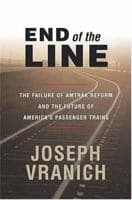
In a critically acclaimed, call-for-action book, transportation expert Vranich explores the numerous transportation problems in the U.S. and offers a hopeful glimpse into a possible era of responsible energy efficient travel. Illus. This description may be from another edition of this product.
Author Joseph Vranich makes a strong case for high-speed rail networks in the USA. As he shows, an East Coast network makes great sense, as do California, Florida, and a Chicago-centered Midwest system. Readers see why high-speed rail can help us avoid highway gridlock and air traffic jams. As many know, a typical 60-minute flight (say, St. Louis-Chicago) often takes 5-6 hours due to airport access, waits, delays, etc. Imagine zipping along by rail at 180 mph with wide seats, laptop ports, a spacious aisle, conference rooms, and dining cars. Such reliable, efficient, high-speed systems exist in France (TGV), Germany (ICE), and several other nations. Granted, these networks are expensive to install, but make great sense over the long-term, as our now-clogged interstates once did back in the 1950's. Since this now-dated book arrived in 1991, Germany, Britain, China, Italy, Spain, Belgium, Holland, Sweden, Taiwan and nominally the USA have joined France and Japan with high-speed trains, France has expanded her network, and Germany now researches 300 mph magnetic levatation. This book provides us with a solid look at an improved, reliable transportation future.
0
★★★★★
A well researched treatise on the future of mass transit
By Thriftbooks.com User, October 30, 1997
The arguments posited by Vranich for a U.S based high speed rail network are so compelling and logically formulated that before completing the book I became a member of an organization devoted to high speed ground transportation. Topics explored include the present state of U.S. passenger railroads (focusing on Amtrak) as well as failed high speed rail initiatives , the politics of mass transportation, the problems faced by a near-saturated automobile/aircraft transportation network, the cutting edge technology in high speed rail occuring in Europe, including the imminent unveiling of magenetically levitated trains (maglev) in both Germany and Japan and a scenario of a future with high speed rail. The author's vision is left somewhat incomplete however as he neglects to explore the logistics of how a high speed rail system will link with other forms of transportation (intra-city rail and/or automated guideway transit systems, in addition to cars/airplanes?) to hopefully develop a superior transportation infrastructure to what is currently in place. Overall though, this is highly thought provoking commentary on how a mode of transportation viewed by most as outdated is in fact our best option for safer, more efficient, environmentally sound and less energy intensive mobility for the 21st century.