


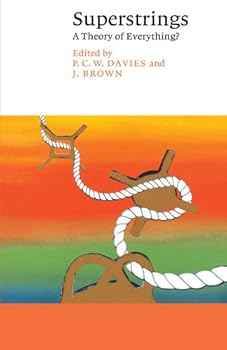
Superstrings: A Theory of Everything? (Canto)


Select Format
Select Condition 
Book Overview
Geared to the layperson, a clear, concise, non-mathematical explanation of the "Theory of Everything" and its profound implications is followed by transcripts of interviews with most of the physicists... This description may be from another edition of this product.
Format:Paperback
Language:English
ISBN:052143775X
ISBN13:9780521437752
Release Date:July 1992
Publisher:Cambridge University Press
Length:248 Pages
Weight:0.65 lbs.
Dimensions:8.5" x 0.6" x 5.5"
Customer Reviews
4 ratings
High standard radio program.
Published by Thriftbooks.com User , 23 years ago
BBC program consisting of interviews with well known physicists about 'superstrings'.This book contains a very good introduction of the quantum theory and of supersymmetry/superstrings for the layman.Most of the interviewed (John Schwarz, Edward Witten, Michael Green, David Gross, John Ellis, Abdus Salam, Steven Weinberg) agree with the theory of superstrings, mainly because it is the only theory that could solve certain mathematical problems (infinities), without violating the laws of quantum mechanics and gravity.Two disagree (Sheldon Glashow and Richard Feynman), mainly because the existence of strings in nature can not be tested.For the moment (see among others, 'The elegant universe' by Brian Greene) it seems that superstrings is the only way to get forward in the search for a 'theory' of everything.Not to be missed. Congratulations to the BBC.
Good introdution, a bit dated.
Published by Thriftbooks.com User , 23 years ago
This little book is a must for those interested in superstring theory. Those who have read books like "the elegant universe" should complement with this one. It gives a historical prespective, but unfortunately is a bit dated, given that it was originally published in 1988. String theory moves real fast, and a lot of things viewed as problems in the book are now somewhat clarified.The book starts with the best crash-course I have read of modern physics. In just 60 pages, you are introduced to supersymmetry, relativity theory, quantum mechanics, particle physics, superstrings, and other conceptual issues. The main body of the book however, involves interviews with various physicists concerning superstrung theory. Green, Gross, Witten, Feynmann, Salam, weinberg among others all give their points of view of this putative "theory of everything". They talk about the structure of the theory, its limitations in experimentation, its main obstacles, and their personal views of what lies in the future for superstrings.Some main issues come up regularily, like the multidimensional aspect of the theory, the fact that there are various diferent superstring theories, and issues on topology. Unfortunately this was before some very interesting results that clarify some of these issues. For example, Calibi-Yau spaces were not in the spotlight, as they currently are. Also, all of this is pre "M-theory". That is, the 5 kinds of theory described (E8*E8 for example) are now linked through "M-theory", so there is no real problem of unification anymore (aty least one could see how it comes together, but this issues are still controversial).Also, current theories sometimes use 11 dimensions, whereas in the book 10 dimensions seemed to be the standard. Holographic principles could also enlighten some of the discussed problems in the book.Another great aspect of the book is that it includes internal critics as well. Richard Feynmann for exaple, does not feel superstring is going to save physics, and does not share the same kind of enthusiasm as say, Edward Witten. The main points are the fact that superstring theory is so far from being directly testable (PLank lenght experiments would require 10 light year long particle accelerators!), and other philosophical issues. Of course, there is circunstancial evidence, but some see that superstring theory resembles pseudo-science in not being directly testable. This is certainly an issue.Wether theory of everything or not, superstring theory is here to stay, so one might as well read this book to get a larger scale view of the field, before reading more modern or popular texts.
A step beyond "The Elegant Universe"
Published by Thriftbooks.com User , 23 years ago
A marvelous summary of varying viewpoints on Superstring Theory and the work that led up to it. I think many readers of "The Elegant Universe" by Brian Greene will find this a natural follow-up, because, though there are no math formulae, it is pitched at a somewhat higher level.Unlike another reviewer, I would highly recommend this to Physicists, aspiring or otherwise, and lay readers with a strong exposure to Physics. Notwithstanding an excellent, lengthy essay by Paul Davies on the history of modern physics up to superstrings, the lay reader who hasn't already taken several runs at quarks, gluons, weak bosons, and the Standard Model of particle physics, is not ready for this. This book is valuable because it displays the creative principles that guide the endeavours of 9 outstanding Physicists. The presence of speculation is not a defect but a stirling virtue of this account. How otherwise can we peer in on gifted minds as they attempt to appraise or develop a pioneering theory at the frontiers of knowledge? They have little to go by except their previous experiences in field theory and core principles such as elegance and self-consistency, or, for some of them, a distrust for wild flights untethered to experiment. Only two of the nine (Glashow and Feynman) sound a strong note of caution and skepticism toward the theory. Feynman as usual is wonderfully thought-provoking, Glashow unexpectedly witty and acerbic, delivering many a shrewd observation. Though a numerical minority, they cast enough doubt to save the reader from uncritical worship at the altar of the pro-string ideology.
A delightful view of the ramifications of string theory
Published by Thriftbooks.com User , 26 years ago
Although this book goes into a little too much advanced theory and mathematics for its intended audience, I applaud the authors for a very well-rounded and candid approach to string theory for the layperson. I have recommended this book to many non-physicist friends of mine, and they have all enjoyed it tremendously. However, I do not recommend this book for aspiring physicists as it (like most books of its type) tends to focus on parts of string theory that have yet to be completely explored; this makes the book highly speculative in my opinion. It's great for a fun read, but I wouldn't put too much confidence in its speculations: they could easily be disproved in the next few years.
Copyright © 2025 Thriftbooks.com
Terms of Use | Privacy Policy | Do Not Sell/Share My Personal Information | Cookie Policy | Cookie Preferences | Accessibility Statement
ThriftBooks ® and the ThriftBooks ® logo are registered trademarks of Thrift Books Global, LLC
ThriftBooks ® and the ThriftBooks ® logo are registered trademarks of Thrift Books Global, LLC
