


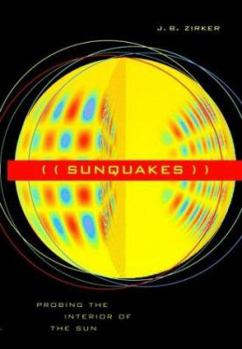
Sunquakes: Probing the Interior of the Sun

One of the newest branches of astronomy, helioseismology - like its terrestrial counterpart - studies why the surface of the sun vibrates like a bell. Since the 1970s, astronomers have gained spectacular insights into the structure and composition of the sun's interior, transforming the way we understand stellar matter. In Sunquakes, Jack B. Zirker tells the story of this new science and explains the physics behind these illuminating vibrations. international efforts throughout the rest of the decade to explain this phenomenon. By the mid-1970s, scientists working independently in France, Germany, Japan and the US had developed a new theoretical model of the sun that postulated the existence of trapped sound and gravity waves as the cause for the roiling of the sun's surface. Using solar oscillation data, scientists derived for the first time the thermal and dynamic properties of the solar interior and revealed its complicated rotation patterns; even such astronomical mysteries as the deficit of solar neutrinos were solved. physicists and other theorists, and the technological innovations that makes solar observation more and more precise, Sunquakes provides professionals and non-scientists alike with an accessible guide to the field of helioseismology. The book concludes with an account of efforts to probe the interiors of stars far beyond our own solar system.
Format:Hardcover
Language:English
ISBN:080187419X
ISBN13:9780801874192
Release Date:October 2003
Publisher:Johns Hopkins University Press
Length:296 Pages
Weight:1.30 lbs.
Dimensions:0.9" x 7.0" x 8.7"
Age Range:18 years and up
Grade Range:Postsecondary and higher
Customer Reviews
1 rating
Detective Story of the Sun
Published by Thriftbooks.com User , 22 years ago
"Sunquakes" is a very well-written and interesting book, that I, as a lay-person with respect to astronomy, had no trouble understanding. I hadn't realized just how much information can be extracted essentially from vibrations that bounce around in different materials. I was glad, however, that I had read the previous book, "Journey from the Center of the Sun", so that I was up on the different layers in the Sun. However, even more interesting than the actual science, was the detective story as one scientist would see some strange anomaly and not be sure whether it was just a fluke or really a clue to a completely new phenomenon. In particular, the dance between observers and theorists showed how real science is done: one person would see something but not understand what caused it. Then a theorist would create models and postulate some explanation. Observers would then try to invent ways to prove or disprove these explanations. In fact, I hope there is a sequel or update over time: some loose ends to this detective story are still dangling.
Copyright © 2026 Thriftbooks.com
Terms of Use | Privacy Policy | Do Not Sell/Share My Personal Information | Cookie Policy | Cookie Preferences | Accessibility Statement
ThriftBooks ® and the ThriftBooks ® logo are registered trademarks of Thrift Books Global, LLC
ThriftBooks ® and the ThriftBooks ® logo are registered trademarks of Thrift Books Global, LLC
