


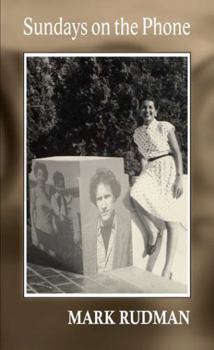
Sundays on the Phone (Wesleyan Poetry Series)


In this moving lyric memoir, Mark Rudman explores his close but often fractious relationship with his mother, and presents a companion volume to his award-winning book, Rider, which concerned his... This description may be from another edition of this product.
Format:Hardcover
Language:English
ISBN:081956785X
ISBN13:9780819567857
Release Date:October 2005
Publisher:Wesleyan University Press
Length:156 Pages
Weight:0.70 lbs.
Dimensions:9.5" x 1.0" x 6.0"
Related Subjects
PoetryCustomer Reviews
2 ratings
Sunday's on the Phone to Monday
Published by Thriftbooks.com User , 17 years ago
Sundays on the Phone ends the Rider series of Mark Rudman's work similarly to how it started - with a moving tribute to a parent. Although Rider (which won the National Book Critics Circle Award) was to his stepfather, an itinerant rabbi, Sundays on the Phone is about - and often written to and in the poet's mother's voice, giving her a forum and a stand that she didn't seem to be able to vent often in her own life. "Tribute" and "elegy" are somewhat inappropriate, as the relationship is often fractious, and to find out why the work benefits from this is worth reading alone. "High Holy Days" returns to the form of the earlier books (a swift, fast-paced dialogue with an italicized voice), "Sundays on the Phone" will one day be recognized as a classic of an American long poem - rigourous, intellectual, relentless, and "Conversion in Scafa" deals with the ineffable in a way that few other poets writing in English can. It's worth picking up the The Couple or The Millenium Hotel or anything that came before it to frame this, but Sundays on the Phone is a rewarding read no matter how you look at it. Diverse Voices: Essays on Poets and Poetry
Don't Neglect This Poet's Work
Published by Thriftbooks.com User , 20 years ago
Like Rider and The Millenium Hotel, Mark Rudman's Sundays on the Phone is a very enjoyable and readable book of poetry. If you read it as a novel, it's right in line with the great Saul Bellow novels, Herzog and Humbolt's Gift. Bellows heroes are like Rudman in his poems-urban and urbane men who delight and trouble over consciousness and personal history in the caverns of Manhattan and the green parts of America. His characters (his maddening, frustrated and loveable mother, his alcoholic stepfather the rabbi) emerge as multi-dimensional and well-rounded, which is something that never happens in isolated lyric poems, not even the best ones, for they can only gesture at such a state of balance of merciless honesty and warmth. If you read the book as poetry, Rudman is post-confessional in a very winning way. He's has the best qualities of Robert Lowell or Frank Bidart-honesty, compassion, a clear-eyed and unsentimental streak-and some of the best qualities of Frank O'Hara-a sensibility that resists the dogmatism of an overly self-serious self-conception of the poet as either a tragic hero or secular priest of the imagination or victim of old wrongs or wounds. When other poets of Rudman's generation write of old music or furniture or summer camp, they tend to throw lyric clunker after clunker as they constrain themselves to the space of the lyric form and their own self-conceptions. If O'Hara had written of his past instead of the present moment, we would have a new standard of memory writing: Rudman's work, where the past is not contained in narrative distance, but is liberated in the freedom of association and precisely rendered detail.
Copyright © 2026 Thriftbooks.com Terms of Use
| Privacy Policy | Do Not
Sell/Share My Personal Information | Cookie Policy | Cookie Preferences | Accessibility Statement
ThriftBooks® and the ThriftBooks® logo are registered trademarks of Thrift Books Global, LLC
ThriftBooks® and the ThriftBooks® logo are registered trademarks of Thrift Books Global, LLC
