


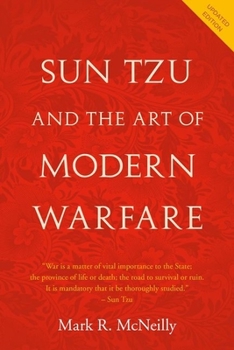
Sun Tzu and the Art of Modern Warfare: Updated Edition


Select Format
Select Condition 
Book Overview
Long acknowledged as a classic text on strategy, Sun Tzu's The Art of War has been admired by leaders as diverse as Mao Zedong and General Norman Schwartzkopf. However, having been written two thousand years ago, the book can be somewhat daunting to the modern reader. Mark McNeilly, author of Sun Tzu and the Art of Business (OUP, 2011), which made Sun Tzu accessible to the business executive, has extracted the six concepts most applicable to modern warfare, making them easy to understand and apply to military situations. Drawing on a wealth of fascinating historical examples, McNeilly shows how these six principles might be used in wars of the future---both conventional wars and terrorist conflicts---and how they can provide insight into current affairs, such as the war on terrorism and China's increasingly important strategic and military role in the world. This updated edition reflects on all that has happened in the past ten years, including the wars in Iraq and Afghanistan, the challenge of Iran, the "Arab Spring," and the continued rise of China. Each chapter includes brand new examples to explain important concepts in The Art of War. Including the full text of The Art of War in the popular translation by Samuel Griffith, with cross-references to quotations used in the book, Sun Tzu and the Art of Modern Warfare unlocks these elusive secrets for anyone interested in strategy and warfare, whether they are professional soldiers, military history buffs, or business executives.
Format:Paperback
Language:English
ISBN:0199957851
ISBN13:9780199957859
Release Date:November 2014
Publisher:Oxford University Press
Length:328 Pages
Weight:1.00 lbs.
Dimensions:0.9" x 6.1" x 9.2"
Customer Reviews
1 rating
A few grains of truth in a lot of chaff.
Published by bernie4444 , 7 months ago
Today, many of Sun Tzu's quotes are floating around mixed with Shakespeare and the Bible. And as with many of the quotes, they are out of context and misleading. The quoter usually thinks that repeating the word is some sort of magic.
This volume at least tries to show the facts of Sun Tzu and not go overboard on popular cultural deviations as to how to apply them to other disciplines. There is an excellent index if you are looking for something specific.
It is easy with hindsight and a closer look at the future to dismiss Sun Tzu as his practical tactical knowledge is of a time and place long gone. He spends a lot of time on the use of weapons and information gathering techniques of the time. This can be interesting in a historical context; otherwise, it is quite amusing.
Oh yes, those grains of truth I mentioned, well, they may sound like clichés, but they are still viable. "Know your enemy and know yourself". Others are just practical sense and statistical outcomes that you learn in any military training. I could go through the list, but again, that is why you buy the book.
Now, just as you decide that the book is outdated for any practical purposes today, we have artillery and now stealth and precision, the reminder that "no two wars are alike" and "it is the flexibility that makes a difference" is still true. Even in today's wars, there is a need for good intelligence and deception. We put a lot of time and energy into Psy-Ops. Sun Tzu shows the advantage of specialized units and crack troops.
I have spent several years in the military and business and can say this book is a nice addition to history, otherwise of very little value to today's world for war or business or anything else that might come up.
Copyright © 2026 Thriftbooks.com
Terms of Use | Privacy Policy | Do Not Sell/Share My Personal Information | Cookie Policy | Cookie Preferences | Accessibility Statement
ThriftBooks ® and the ThriftBooks ® logo are registered trademarks of Thrift Books Global, LLC
ThriftBooks ® and the ThriftBooks ® logo are registered trademarks of Thrift Books Global, LLC
