


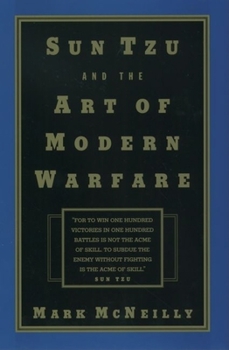
Sun Tzu and the Art of Modern Warfare


Select Format
Select Condition 
Book Overview
Long acknowledged as a classic text on strategy, Sun Tzu's The Art of War had been admired by leaders as diverse as Mao Zedong and General Norman Schwartzkopf. However, written two thousand years old, the book can often be hard to fathom.
Now Mark McNeilly, author of Sun Tzu and the Art of Business, which made Sun Tzu accessible to the business executive, has extracted six concepts most applicable to modern warfare, making them easy to understand and apply to military situations. Drawing on a wealth of fascinating historical examples, McNeilly shows how these six principles might be used in wars of the future--limited actions, regional conflicts--and how they can provide insight into current affairs, such as the future course of China's increasingly important strategic and military role in the world. He describes how to win the information war, how to lead by example, and how to use alliances to defeat the opponent. Perhaps the most important lesson to be learned from Sun Tzu, especially for strategists who want to maximize their resources, is how to "win without fighting". And, should fighting be unavoidable, victory should be achieved in a manner that minimizes losses, leaves the victor stronger and ensures a lasting peace.
Including the full text of The Art of War in the popular Griffith translation, with cross-references to quotations used in the book, Sun Tzu and the Art of Modern Warfare unlocks these elusive secrets for anyone interested in strategy and warfare, whether they are professional soldiers, military history buffs, or business executives.
Now Mark McNeilly, author of Sun Tzu and the Art of Business, which made Sun Tzu accessible to the business executive, has extracted six concepts most applicable to modern warfare, making them easy to understand and apply to military situations. Drawing on a wealth of fascinating historical examples, McNeilly shows how these six principles might be used in wars of the future--limited actions, regional conflicts--and how they can provide insight into current affairs, such as the future course of China's increasingly important strategic and military role in the world. He describes how to win the information war, how to lead by example, and how to use alliances to defeat the opponent. Perhaps the most important lesson to be learned from Sun Tzu, especially for strategists who want to maximize their resources, is how to "win without fighting". And, should fighting be unavoidable, victory should be achieved in a manner that minimizes losses, leaves the victor stronger and ensures a lasting peace.
Including the full text of The Art of War in the popular Griffith translation, with cross-references to quotations used in the book, Sun Tzu and the Art of Modern Warfare unlocks these elusive secrets for anyone interested in strategy and warfare, whether they are professional soldiers, military history buffs, or business executives.
Format:Hardcover
Language:English
ISBN:0195133404
ISBN13:9780195133400
Release Date:November 2001
Publisher:Oxford University Press
Length:320 Pages
Weight:1.32 lbs.
Dimensions:9.1" x 1.3" x 6.0"
Related Subjects
Business Business & Finance Business & Investing Decision-Making & Problem Solving Economics Engineering Entrepreneurship History Leadership Management & Leadership Military Military Science Military Sciences Science & Math Small Business & Entrepreneurship Social Sciences Strategy Strategy & Competition Technology TextbooksCustomer Reviews
5 ratings
A few grains of truth in a lot of chaff.
Published by bernie4444 , 8 days ago
Today, many of Sun Tzu's quotes are floating around mixed with Shakespeare and the Bible. And as with many of the quotes, they are out of context and misleading. The quoter usually thinks that repeating the word is some sort of magic.
This volume at least tries to show the facts of Sun Tzu and not go overboard on popular cultural deviations as to how to apply them to other disciplines. There is an excellent index if you are looking for something specific.
It is easy with hindsight and a closer look at the future to dismiss Sun Tzu as his practical tactical knowledge is of a time and place long gone. He spends a lot of time on the use of weapons and information gathering techniques of the time. This can be interesting in a historical context; otherwise, it is quite amusing.
Oh yes, those grains of truth I mentioned, well, they may sound like clichés, but they are still viable. "Know your enemy and know yourself". Others are just practical sense and statistical outcomes that you learn in any military training. I could go through the list, but again, that is why you buy the book.
Now, just as you decide that the book is outdated for any practical purposes today, we have artillery and now stealth and precision, the reminder that "no two wars are alike" and "it is the flexibility that makes a difference" is still true. Even in today's wars, there is a need for good intelligence and deception. We put a lot of time and energy into Psy-Ops. Sun Tzu shows the advantage of specialized units and crack troops.
I have spent several years in the military and business and can say this book is a nice addition to history, otherwise of very little value to today's world for war or business.
Sun Tzu for the Western World
Published by Thriftbooks.com User , 22 years ago
It is basically the author's interpretation of Sun Tzu's the Art of War and applies it to modern military strategy. The book also puts it in Western context using Western military battles as examples. I liked the author's grouping of the teachings into principles and the examples that he gives. Also his chapter on Sun Tzu and terrorism gives the book a relevant feel. I'd definitely recommend this to anyone who wants to get a grasp on the ides of the ideas of The Art of War, especially in a Western context. But I would also highly recommend reading through the translation of the original at the end of the book. I give this an A on the StuPage.
A window into the past will open many doors in the future
Published by Thriftbooks.com User , 24 years ago
Mark McNeilly takes the principles of Sun Tzu and lays them out in 6 easy to understand categories. These 6 principles are then described and examples of their use in modern warfare are given. This book is invaluable to anyone studying strategy in any capacity. It plainly demonstrates the value of Sun Tzu's words and the peril one can face if they are ignored.There is also a translation by Samual Griffith of the original "Art of War" by Sun Tzu. So in affect you are getting 2 books in one. You can't beat that.On a more serious note this book is a wake up call to those of you who do not understand Eastern Philosophy and Warfare. With the emergence of China as an ever growing influence in the world, it would serve everyone well to understand their history, culture and principles. This book is invaluable in the capacity.
Timeless and Timely "Principles"
Published by Thriftbooks.com User , 24 years ago
Those who have already read McNeilly's previous and brilliant book, Sun Tzu and the Art of Business, will welcome this study of modern warfare at a time when the term "war" seems to be undergoing constant re-definition. Events on and subsequent to September 11th have required all of us to view warfare from different perspectives. That process continues even as we await further developments. In this volume, McNeilly reminds us that there are certain fundamental principles of warfare which have remained valid throughout the centuries. Perhaps the first management consultant, Sun Tzu asserts in The Art of War that all battles are won or lost before they are fought. Moreover, he insists that it is better, far better to gain victory without having to engage in combat. Once combat is necessary, he suggests all manner of strategies and tactics by which to overcome an opponent. As you read this review, I suspect that certain warriors throughout the world (perhaps having never read nor heard of Sun Tzu) are utilizing many of these same strategies and tactics. Why? Because they are effective.After a brief but highly informative Introduction ("The Relevance of Sun Tzu to Modern Warfare"), McNeilly examines the aforementioned "fundamental principles" within six chapters, citing numerous examples drawn from the history of modern warfare, and then provides his own "Conclusions" about "ancient principles for future battlefields." He includes in this volume the superb translation of The Art of War by Samuel B. Griffith. Here are the six chapter titles:Win All Without Fighting [how to achieve the objective without destroying it]Avoid Strength, Attack Weakness [strike only where the enemy is most vulnerable]Deception and Foreknowledge [how to win the information war]Speed and Preparation [moving swiftly to overcome resistance decisively]Shaping the Enemy [selecting and preparing the battlefield to your advantage]Character-based Leadership [leading by example]Obviously, merely listing the chapter titles and suggesting the thrust of each cannot indicate the scope and depth of McNeilly's achievements in this book. But perhaps it would be helpful to share two brief excerpts from his Preface and then from the final chapter, Conclusions:"My interest in writing this book stems from a deep interest in military history, my attraction to the ideas and concepts put forth by Sun Tzu, my experience as an infantry officer, and my time as a strategist for a major global corporation. These forces, plus the desire to ensure that students of strategy have greater exposure to and understanding of Sun Tzu's holistic strategic philosophy, compelled me to pen this work.""Thus, two things are clear. First, neither strategic nor tactical excellence is sufficient by itself; the two must accompany one another for decisive victory. If a nation has the right strategy but executes it poorly, it will not be successful. Similarly, a nation that executes a poor strategy with excellence will also
Sun Tzu Simplified and Updated for Government Leaders
Published by Thriftbooks.com User , 24 years ago
Most people who study military strategy rank Sun Tzu among the leading thinkers of all time. In this interesting book, Sun Tzu's ideas are usually compared to some of the grand strategic concepts of Clausewitz who influenced so many military thinkers in the 20th century, especially the Germans in World Wars I and II. Mr. McNeilly also effectively uses the differences between the Asian game of "Go" and Chess to examplify the different mindsets. I highly recommend this book to all those who wish to better understand sound principles for defending a nation's freedom. As I read Sun Tzu and the Art of Modern Warfare, I couldn't avoid thinking that these same principles could be usefully applied to establishing policies for protecting nations from terrorism. In particular, Sun Tzu pointed out that `to win one hundred victories in one hundred battles is not the acme of skill." "[T}o subdue the enemy without fighting is the acme of skill." For example, how could the community of nations jointly create and support a system that left international terrorists no place to hide, no way to get aid, and no recognition for their evil deeds? In the last few decades, Sun Tzu has become better known as a source of inspiration for business strategists than for military ones. In fact, Mr. McNeilly wrote a superb book last year on just that subject, Sun Tzu and the Art of Business. While reading that book, I was very impressed with the modern military examples, and am glad to see even more such examples in Sun Tzu and the Art of Modern Warfare. An important reason for reshaping Sun Tzu has been that his ideas have to be simplified and reframed to apply to business, a major new arena for strategic thinking. Many military strategists, however, are reluctant to "mess" with an obvious classic. By leaving Sun Tzu in the original form for its military content, much of the power of the writing is lost to those who wish to think about government policies today for domestic, foreign, and military matters. To me, Sun Tzu and the Art of Modern Warfare provides a valuable service by making this outstanding work easily accessible to both those with and without military experience who live now in North America or Europe. The book does this in three ways. First, it simplifies the overall message of Sun Tzu into six major principles. Second, the book uses many examples from 19th and 20th century North American and European battles, supplemented with occasional references to the ancient Greek campaigns in Asia, the Punic Wars, and the World War II, Korean, and Vietnamese warfare in the Pacific and Asia. The more recent war to oust Iran from Kuwait is also included as a counterpoint to many military errors in other campaigns. Third, the volume both quotes copiously from Sun Tzu and includes a complete copy of Samuel B. Griffith's translation of The Art of War. As someone without a military history background, I appreciated the simplified exhibits that showed the
Copyright © 2026 Thriftbooks.com Terms of Use
| Privacy Policy | Do Not
Sell/Share My Personal Information | Cookie Policy | Cookie Preferences | Accessibility Statement
ThriftBooks® and the ThriftBooks® logo are registered trademarks of Thrift Books Global, LLC
ThriftBooks® and the ThriftBooks® logo are registered trademarks of Thrift Books Global, LLC
