


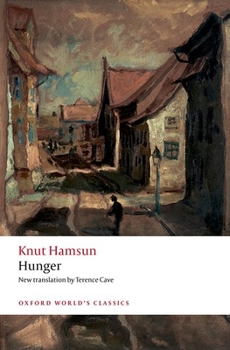
Hunger


Select Format
Select Condition 
Book Overview
'It was at the time when I was wandering around hungry in Kristiania, that strange city no one leaves before it has set its mark on them...' Hunger is the first-person story of a young man desperately trying to establish himself in the city as a writer, living in shabby lodgings where he can seldom afford to pay the rent, eating almost nothing, and engaging spasmodically and manically with landladies, eccentric elderly men, policemen, shopkeepers, pawnbrokers, and others on the way. He wanders around the streets, sits on benches trying to write, spends a night locked in a pitch-dark police cell, thinks, slides into remarkably inventive reveries, speculates on his mental health, his ethical comportment, his relation to the divinity, the topics he might write about. The traces of a consistent narrative logic are uncertain and blurred; the voice of the narrator keeps shifting between pragmatic appraisal of his situation, wild fantasies, manic outbursts, anger, and despair. This is a story that lies on the threshold of modernism, anticipating many of the dislocations that narrative will be subject to in the decades to come. This new translation seeks to restore the startling freshness and epidermal unease of Hamsun's breakthrough story of 1890. It remains faithful to the style and voice of the text, the shifts of tense, the indirect free style, and the constant changes of register as the inner monologue moves between poetic sensitivity, wild fantasies, manic outbursts, and hyperbolic emotion. Tore Rem's introduction provides an updated and fresh account of the genesis of Hunger, its book history and its reception. ABOUT THE SERIES: For over 100 years Oxford World's Classics has made available the widest range of literature from around the globe. Each affordable volume reflects Oxford's commitment to scholarship, providing the most accurate text plus a wealth of other valuable features, including expert introductions by leading authorities, helpful notes to clarify the text, up-to-date bibliographies for further study, and much more.
Format:Paperback
Language:English
ISBN:0192862847
ISBN13:9780192862846
Release Date:February 2024
Publisher:Oxford University Press
Length:224 Pages
Weight:0.42 lbs.
Dimensions:0.7" x 5.2" x 7.4"
Customer Reviews
6 ratings
Hungry
Published by Labradax , 1 year ago
Another protagonist that stresses you out!
Excellent character study
Published by Thriftbooks.com User , 16 years ago
I enjoyed reading this insightful and interesting character study of a writer and his mental and physical struggles. The author takes you inside the flawed characters mind like no other book I have read has ever done. I found it fasinating. The mind and where it can take you is examined in this wonderful book.
the far edge of madness
Published by Thriftbooks.com User , 16 years ago
This is an older novel, written in the 1930's or thereabouts. It was originally in Norwegian, and the author later won a Nobel Prize for Growth of the Soil, which I haven't started yet. All the reviews said this was a disturbing novel of isolation. It was, and is, fascinating. The protagonist, writing in the first person, describes his life as a writer who has suffered hunger and starvation long enough that his mental faculties are injured beyond repair (it would seem). He writes occasionally for a newspaper, makes enough to get by a few days if his story is purchased, or goes without food for days if it doesn't get picked up. The malnourishment causes a variety of problems, from extreme mood swings to paranoia to hallucinations. He takes to chewing on wood shavings, then stones, then a piece of his jacket pocket to try and defy the hunger. When he does eat, he is usually ill from the food. He gets to a point where he visualizes taking a bite out of his hand to eat, and does so. He comes out of his trance when he does, but it shows how far out of reality he became. A few times he either finds money or is given some by a benevolent person; he simply can't accept this, and gives it away. The insanity is beyond anything I imagined. Perhaps because it's told in first person style, where every thought and inkling is described and explored. The people he harasses, the fights he starts, his visions of his own talent (highly inflated) and his paranoia are frightening. He has tremendous pride, not wanting to take help from others, even when he hasn't eaten for days. One shopkeeper, realizing his situation, actually pretends to make a mistake and gives him too much change...rather than take this for food, he gives it to a more 'impoverished' soul than him. It's not that he's selfless, far from it. His pride consumes him. He can't bear to imagine anyone thinking badly of him, even when he is selling off his clothing and the buttons on his coat. He even has the opportunity to make use of a homeless shelter to get food and a bed, and he refuses rather than to look bad. Physically, the starvation manifests itself in losing his hair in clumps, a peeling skin rash and raw skin from his dirty clothes rubbing his skin, blackened nails, lost teeth, and a chronic dizziness and fever. I was amazed in that while he did write to earn money, he never seemed to try and seriously find a job. And he never seemed to consider stealing, which would have occurred to me before I would be chewing on stones. Again, it wasn't out of honor, it was about his perception of what others would think of him, and he wanted to be thought of as honorable, even though he wasn't. He was truly isolated. No family is mentioned, his only friends are actually acquaintances that avoid him because of his strange behavior and pathetic appearance, exactly what he was hoping to avoid. I couldn't help but wonder what kind of child he was (okay, I know it's fictional but I still think this way) a
Man desperately seeking a happy meal...
Published by Thriftbooks.com User , 17 years ago
Knut Hamsun's *Hunger* is a powerful study of a man too intelligent and too sensitive for his own good--or anyone else's for that matter. He's a younger version of Dostoyevsky's "underground man" driven by Poe's "imp of the perverse." Living hand-to-mouth, always down to his last kroner, reeling dizzy from hunger, Hamsun's narrator, a freelance journalist and would-be litterateur, is part crank, part brilliant eccentric whose hypersensitivity and untimely observations of the shortcomings of human nature seem to insure his failure among the society he loathes. The victim as well as the author of his own misfortunes, the hero--properly speaking, the anti-hero--of *Hunger* can't even stumble into good fortune without somehow sabotaging himself. He pushes himself to indulge in the most offensive and inappropriate public behavior so compulsively you begin to wonder if he isn't insane, especially inasmuch as he often engages himself in conversation and goads himself to self-destruction as if he were really talking to and arguing with another person altogether. He even manages to spoil the beginnings of a most improbable love-affair with a woman who finds herself intrigued by such a strange and haunted man. Is his poverty, his periodic homelessness, his ever-present hunger a consequence of his schizoid behavior or is his schizoid behavior a consequence of his hunger, grinding poverty, and brutal degradation at the hands of a society that doesn't recognize the geniuses among it? The question is left open to debate and that's one of the things that makes *Hunger* such an endlessly compelling novel. By articulating such questions and outlining the contours of alienation, Hamsun paints a bleak landscape where genius struggles between mediocrity and madness and where each of us is not much more than a ham sandwich away from being swallowed up by utter destitution.
a peaceful glimpse into the insanity of us all
Published by Thriftbooks.com User , 17 years ago
somewhat autobiographical and you can tell as he deals with issues of human selfishness and his own follies and strict code. it was funny. right before the ending, i was wondering why this never occurred to him and then bam, last page. anyways...a great look into the psyche of a man and his evaluation of himself and the world around him.
A borderline genius whose art forbids living
Published by Thriftbooks.com User , 26 years ago
Partly autobiographical, this novel describes the life of a borderline genius whose process of writing is only fertile when his stomach's empty. He seems able to touch perfection in his art, but the very element that lends him creativity also inhibits it, as he's too hungry to properly get to work. On better days, he doesn't work either, as his stomach's too full...Hamsun explores the psychological effects of extreme hunger on this young intellectual, and, not unlike his protagonist, he touches perfection in this splendidly written, very short and concise novel that even makes the reader feel hungry. Hamsun's sense of humour is underrated - the book also has rather a lot of comedy to it.
Hunger (Sult) Mentions in Our Blog

Every Book Read in The White Lotus Season 3
Published by ThriftBooks and Likewise • May 06, 2025
Explore the compelling selections from Season 3 of The White Lotus, bringing together an eclectic mix of memoirs, fiction, and self-help books that reflect on the complexities of life, identity, and personal growth.
Copyright © 2026 Thriftbooks.com Terms of Use
| Privacy Policy | Do Not
Sell/Share My Personal Information | Cookie Policy | Cookie Preferences | Accessibility Statement
ThriftBooks® and the ThriftBooks® logo are registered trademarks of Thrift Books Global, LLC
ThriftBooks® and the ThriftBooks® logo are registered trademarks of Thrift Books Global, LLC
