


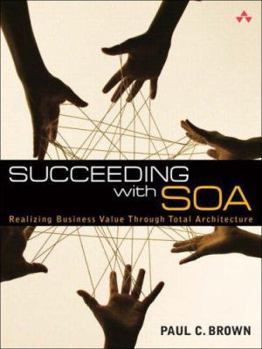
Succeeding with Soa: Realizing Business Value Through Total Architecture

""Like so many acronyms in public currency, SOA means many different things to different people. Paul Brown deftly avoids getting caught in the trap of overstating the case for SOA. Instead, he brings... This description may be from another edition of this product.
Format:Paperback
Language:English
ISBN:0321508912
ISBN13:9780321508911
Release Date:April 2007
Publisher:Addison Wesley Professional
Length:288 Pages
Weight:1.22 lbs.
Dimensions:0.7" x 7.1" x 9.2"
Related Subjects
Business & Finance Business & Management Computer Science Computers Computers & Technology Design & Architecture Education & Reference Manager's Guides to Computing Network Administration Networking Networks Networks, Protocols & APIs New Business Enterprises Small Business & Entrepreneurship Textbooks Web Development & Design Web ServicesCustomer Reviews
4 ratings
SOA Bible!
Published by Thriftbooks.com User , 15 years ago
I just finished reading Succeeding with SOA by Paul C. Brown. First let me start by saying that Service Oriented Architecture has been a widely discussed and presented topic in the architecture space. That being said, Paul presents it from a new perspective that interwinds the business and technology aspects and implications of designing/implementing an SOA architecture. This paradigm (Total Architecture), recognizes the fact that underpinning a successful architecture is the effective interplay of business process, people, information and systems. The author than goes on to discuss each of these areas in great detail. On the business process sides, one of the highlights is around ensuring the processes are well owned, understood, documented and measured. The later enables the tracking of metrics to ensure that any subsequent changes/modifications can be benchmarked for improvement. On the people side, the organization must have proper project/program structure and governance to ensure the effective design and implementation of the desired architecture. This structure must ensure that incentives and goals are aligned, across business silos, to ensure the successful implementation of enterprise services. On the information and services side, discussions around what constitutes a service and best practices around designing them are presented. As mentioned, the aspect that resonates with me the most is the level of engagement required with the business side (non-IT) to ensure a successful SOA or for that mater any architecture. This is not a journey IT can lead on its own. This in turn reflects itself on changes not only in the underlying business processes but the behavior/culture of the people. Overall a great and enjoyable read for business and IT folks alike who are considering/interested in Service Oriented Architecture. Looking forward to reading the followup implementation guide/book by the same author! Highly recommended.
Perfect for setting realistic goals in the business/IT environment.
Published by Thriftbooks.com User , 19 years ago
From how to create complete rich client applications using the platform to handling plugins, no serious developer's library should be without RICH CLIENT PROGRAMMING. Paul C. Brown's SUCCEEDING WITH SOA: REALIZING BUSINESS VALUE THROUGH TOTAL ARCHITECTURE is for any information technology library beyond the beginner's level. Both business and computer collections receive a definitive guide to service-oriented architectures and how they may be understood and implemented. With an emphasis on reasons for common failures, the author draws important connections business managers and IT architects need to know for optimum results. Perfect for setting realistic goals in the business/IT environment.
combine business processes and IT
Published by Thriftbooks.com User , 19 years ago
Brown emphasises here what he calls the total architecture. A unified view of business processes and information systems within a company. He suggests that getting this view and then using it to implement a Service Oriented Architecture is far more conducive to succeeding, than by merely focusing on the information systems. Implicitly, there is a contrast between this approach and those offered by earlier SOA books, like Service-Oriented Architecture (SOA): Concepts, Technology, and Design (The Prentice Hall Service-Oriented Computing Series from Thomas Erl). It and several others that appeared in the last 2 years tended to focus on the XML nomenclature for instantiating an SOA. Important, but the tendency was to emphasise what are essentially lower level details. In Brown's book, there is no overwhelming you with scads of XML. Actually, there are no XML examples. He stays at a higher level of design, not implementation. One perhaps better suited to business managers. The book also stresses an ongoing Total Architecture Synthesis. Where this synthesis is often evaluated as the implementation of SOA proceeds. So that rather than large discrete steps, like a waterfall approach, it tends to be smaller, agile-like re-evaluations. He suggests that this is more likely to work. Plus, there is a real added benefit that it can keep a top level, nontechnical manager closely involved as the SOA is built out. Reducing the chance of a drifting apart of the business and IT aspects. Risk reduction is vital.
SOA 2.0 book
Published by Thriftbooks.com User , 19 years ago
This book is really the next generation of SOA books. We all know how to slap WSDL on top of Java/C# class, now what? Too many organizations approached SOA as technological novelty and now have a wild assortment of unversioned, undescribed, un-reusable Web Services lying around. This book really explains how to turn this mess into a real architecture. It points out, with case studies, abundant diagrams, and in easy to read language, how to plan, organize and architect SOA projects.
Copyright © 2026 Thriftbooks.com
Terms of Use | Privacy Policy | Do Not Sell/Share My Personal Information | Cookie Policy | Cookie Preferences | Accessibility Statement
ThriftBooks ® and the ThriftBooks ® logo are registered trademarks of Thrift Books Global, LLC
ThriftBooks ® and the ThriftBooks ® logo are registered trademarks of Thrift Books Global, LLC
