


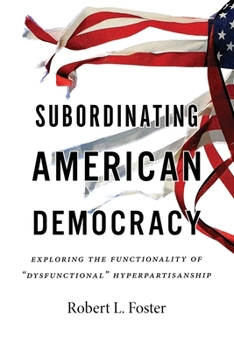
Subordinating American Democracy: Exploring the Functionality of "Dysfunctional" Hyperpartisanship
No Customer Reviews

"Robert L. Foster writes that the hyperpartisanship which currently afflicts America's political and social discourse has developed into a malignancy that perverts self-determination, exalts zero-sum solutions, and] diminishes democracy's functionality. . .. He also persuasively asserts that media fragmentation 'provides soft environments for partisans , ]' because ' w]eak arguments are given a free pass , ]' ' f]lawed logic is overlooked , ]' and 'mediocrity thrives.'" - JEFFREY M. WINN, NEW YORK LAW JOURNAL
"Foster's book serves as a timely and urgent call for a shift in how Americans engage with politics. . .. 'Subordinating American Democracy' provides a comprehensive and thought-provoking analysis of the challenges facing American democracy today." - SWAPNA PERI, BOOK REVIEWS CAFE How Can a "Dysfunctional" Phenomenon Evolve and Perpetuate? Since WWII, America has been considered the quintessential democratic superpower. Yet between the economic beehive of private sector freedom and the responsibility of constitutional democracy, debilitating polarity threatens the archetype. In Subordinating American Democracy, Robert L. Foster uses an analytical framework based on evolutionary theory and ecological principles to explore how hyperpartisanship thrives within our ecosystem. Examining relationships within and between the private and public sectors delineates an extensive hyperpartisan web supported by institutional and systemic structuring, cultural trends including partisan segregation or tribalism, and human psychology. Subordinating American Democracy cuts through the trendy hype of partisan media analysis to articulate hyperpartisanship's functionality. Through financial incentivization, psychological appeasement, and tribal bullying, hyperpartisanship supersedes functional democracy. Subordinating American Democracy inspires readers to consider subtle aspects of their relationship with democratic instrumentalities and discover pathways toward constitutional functionality.Format:Paperback
Language:English
ISBN:B0DT2LYT7Q
ISBN13:9798991073202
Release Date:March 2025
Publisher:Beautiful Hybrid Publications
Length:484 Pages
Weight:1.41 lbs.
Dimensions:1.0" x 6.0" x 9.0"
Related Subjects
PhilosophyCustomer Reviews
0 rating
Copyright © 2026 Thriftbooks.com Terms of Use
| Privacy Policy | Do Not
Sell/Share My Personal Information | Cookie Policy | Cookie Preferences | Accessibility Statement
ThriftBooks® and the ThriftBooks® logo are registered trademarks of Thrift Books Global, LLC
ThriftBooks® and the ThriftBooks® logo are registered trademarks of Thrift Books Global, LLC
