


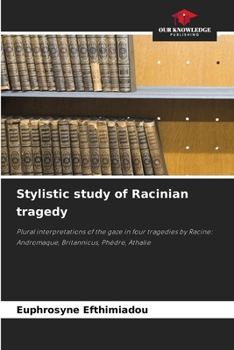
Stylistic study of Racinian tragedy
No Customer Reviews

In the second third of the 17th century, Racine devoted himself to the theatrical genre of tragedy, and more specifically, to the psychological study of his heroes. Racine's tragedies are of fundamental interest for their meticulous study of characters, reflecting their emotional and affective state as they act out their roles. In this respect, the stylistic approach based on multiple interpretations of the gaze is of major importance in highlighting the psychology and actions of the heroes that lead to tragedy. Racine draws on the lexical repertoire of pastoral and neo-Platonic vocabulary for the gaze, but gives it new meaning. On the one hand, the heroes' gaze remains dazzled and immobilized before the being that fascinates it, seeking communication in order to assert its presence. On the other, feelings arise from the hearts of the characters, who remain dominated by their desires. Finally, the spirit intervenes to question the profound nature of the upheaval the beings are undergoing.
Format:Paperback
Language:English
ISBN:6208521114
ISBN13:9786208521110
Release Date:December 2024
Publisher:Our Knowledge Publishing
Length:92 Pages
Weight:0.32 lbs.
Dimensions:0.2" x 6.0" x 9.0"
Related Subjects
Language ArtsCustomer Reviews
0 rating
Copyright © 2026 Thriftbooks.com Terms of Use
| Privacy Policy | Do Not
Sell/Share My Personal Information | Cookie Policy | Cookie Preferences | Accessibility Statement
ThriftBooks® and the ThriftBooks® logo are registered trademarks of Thrift Books Global, LLC
ThriftBooks® and the ThriftBooks® logo are registered trademarks of Thrift Books Global, LLC
