


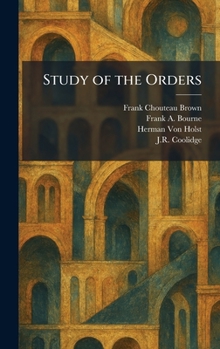
Study of the Orders

"Study of the Orders" is a comprehensive and authoritative guide to the fundamental principles of classical architecture. Written by a distinguished group of experts including Frank Chouteau Brown, Frank A. Bourne, and Herman Von Holst, this work serves as an essential manual for understanding the proportions, details, and historical evolution of the classical orders. The text meticulously explores the five major orders-the Tuscan, Doric, Ionic, Corinthian, and Composite-providing detailed analysis and precise plates that illustrate the refined aesthetics of Greek and Roman traditions.
This volume is designed for both the practicing architect and the serious student of design, offering a clear pedagogical approach to the complex geometry and artistic standards of antiquity. Beyond mere technical instruction, the authors delve into the spirit of classical composition, explaining how these timeless forms provide a foundation for balance and harmony in building. Through its rigorous examination of columns, entablatures, and ornamentation, "Study of the Orders" remains a seminal reference for anyone seeking to master the vocabulary of traditional architecture. It stands as a testament to the enduring influence of classical beauty and the technical precision required to replicate it in modern drafting and construction.
This work has been selected by scholars as being culturally important, and is part of the knowledge base of civilization as we know it. This work was reproduced from the original artifact, and remains as true to the original work as possible. Therefore, you may see the original copyright references, library stamps (as most of these works have been housed in our most important libraries around the world), and other notations in the work.
This work is in the public domain in the United States of America, and possibly other nations. Within the United States, you may freely copy and distribute this work, as no entity (individual or corporate) has a copyright on the body of the work.
As a reproduction of a historical artifact, this work may contain missing or blurred pages, poor pictures, errant marks, etc. Scholars believe, and we concur, that this work is important enough to be preserved, reproduced, and made generally available to the public. We appreciate your support of the preservation process, and thank you for being an important part of keeping this knowledge alive and relevant.
Related Subjects
ArchitectureCustomer Reviews
ThriftBooks ® and the ThriftBooks ® logo are registered trademarks of Thrift Books Global, LLC
