


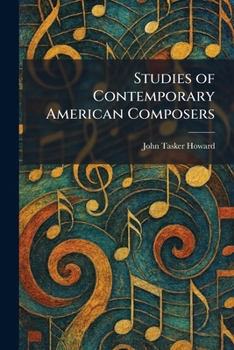
Studies of Contemporary American Composers

"Studies of Contemporary American Composers" offers an insightful and comprehensive examination of the evolving musical landscape in the United States during the early twentieth century. Written by the esteemed music historian John Tasker Howard, this collection of essays provides detailed profiles and critical evaluations of the most influential figures in American music at the time. The work delves into the unique stylistic developments, personal backgrounds, and creative contributions of composers who sought to forge a distinct national identity in a field long dominated by European traditions.
Through careful analysis of technical mastery and artistic vision, Howard explores how these artists integrated folk elements, modern techniques, and native sensibilities into their compositions. "Studies of Contemporary American Composers" serves as a vital historical record of a transformative era, capturing the spirit of a burgeoning American classical tradition and the visionary individuals who defined it. This work is an essential resource for scholars, musicians, and anyone interested in the development of American culture and the rich legacy of its modern orchestral and chamber music.
This work has been selected by scholars as being culturally important, and is part of the knowledge base of civilization as we know it. This work was reproduced from the original artifact, and remains as true to the original work as possible. Therefore, you may see the original copyright references, library stamps (as most of these works have been housed in our most important libraries around the world), and other notations in the work.
This work is in the public domain in the United States of America, and possibly other nations. Within the United States, you may freely copy and distribute this work, as no entity (individual or corporate) has a copyright on the body of the work.
As a reproduction of a historical artifact, this work may contain missing or blurred pages, poor pictures, errant marks, etc. Scholars believe, and we concur, that this work is important enough to be preserved, reproduced, and made generally available to the public. We appreciate your support of the preservation process, and thank you for being an important part of keeping this knowledge alive and relevant.
Customer Reviews
ThriftBooks ® and the ThriftBooks ® logo are registered trademarks of Thrift Books Global, LLC
