


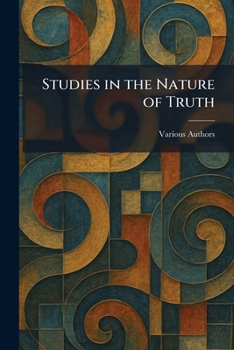
Studies in the Nature of Truth

"Studies in the Nature of Truth" is a significant collection of philosophical inquiries exploring the foundational concepts of reality, perception, and logical verification. This work brings together diverse intellectual perspectives to address one of the most enduring questions in human thought: What is truth? Comprising various scholarly lectures, the text serves as a rigorous examination of the structures that define human knowledge and certainty.
The contributors delve into various aspects of epistemology and metaphysics, examining how truth relates to language, belief systems, and the empirical world. From discussions on the coherence and correspondence theories of truth to the psychological dimensions of conviction, the essays provide a comprehensive survey of early 20th-century philosophical thought. Readers will find deep explorations of how human understanding is shaped by both logical frameworks and subjective experiences.
This volume serves as an essential resource for students and scholars of philosophy, offering timeless insights into the nature of knowledge and the criteria for certainty. By synthesizing logic, ethics, and metaphysics, "Studies in the Nature of Truth" remains a profound testament to the pursuit of intellectual clarity and the systematic investigation of the principles that govern our grasp of reality.
This work has been selected by scholars as being culturally important, and is part of the knowledge base of civilization as we know it. This work was reproduced from the original artifact, and remains as true to the original work as possible. Therefore, you may see the original copyright references, library stamps (as most of these works have been housed in our most important libraries around the world), and other notations in the work.
This work is in the public domain in the United States of America, and possibly other nations. Within the United States, you may freely copy and distribute this work, as no entity (individual or corporate) has a copyright on the body of the work.
As a reproduction of a historical artifact, this work may contain missing or blurred pages, poor pictures, errant marks, etc. Scholars believe, and we concur, that this work is important enough to be preserved, reproduced, and made generally available to the public. We appreciate your support of the preservation process, and thank you for being an important part of keeping this knowledge alive and relevant.
Related Subjects
PhilosophyCustomer Reviews
ThriftBooks ® and the ThriftBooks ® logo are registered trademarks of Thrift Books Global, LLC
