


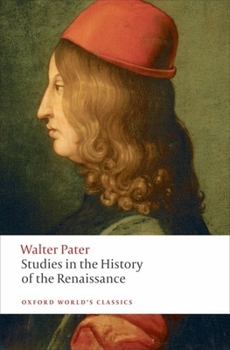
Studies in the History of the Renaissance

Select Format
Select Condition 
Book Overview
Through his highly idiosyncratic readings of some of the finest paintings, sculptures, and poems of the French and Italian Renaissance, Walter Pater in Studies in the History of the Renaissance redefined the practice of criticism as an impressionistic, almost erotic exploration of the critic's aesthetic responses. Pater's infamous "Conclusion," which forever linked him with the decadent movement, scandalized many with its insistence on making pleasure the sole motive of life, even as it charmed fellow aesthetes such as Oscar Wilde. This edition of Studies reproduces the text of the first edition of 1873. Matthew Beaumont's Introduction describes the cultural context that gave rise to the book, the reasons for its notoriety, Pater's philosophical outlook, and the arguments in his book. It explores Pater's work as an attempt to preserve the unique aesthetic of a work of art in the face of encroaching mass culture. The book also includes the later chapter on Giorgione as an Appendix, comprehensive notes that identify the many literary and artistic references, and a useful glossary of names. About the Series: For over 100 years Oxford World's Classics has made available the broadest spectrum of literature from around the globe. Each affordable volume reflects Oxford's commitment to scholarship, providing the most accurate text plus a wealth of other valuable features, including expert introductions by leading authorities, voluminous notes to clarify the text, up-to-date bibliographies for further study, and much more.
Format:Paperback
Language:English
ISBN:0199535078
ISBN13:9780199535071
Release Date:April 2010
Publisher:Oxford University Press
Length:240 Pages
Weight:0.65 lbs.
Dimensions:0.6" x 5.1" x 7.7"
Customer Reviews
3 ratings
Paterphilia perpetuates puissant pulsations?
Published by Thriftbooks.com User , 22 years ago
The Conclusion which crowns this, the most perfect book in the English language should be memorised and chanted sutra-like on a daily basis.
Impressionism in criticism...travel at your own risk...
Published by Thriftbooks.com User , 23 years ago
This work by Walter Pater, published in 1873, asa volume of collected (previously published) essaysalong with an essay on "Winckelmann", a Preface, anda Conclusion was [and perhaps still is] an extremelyinfluential work of aesthetic criticism. The volumehelped shape [influence] the perceptions, theattitudes, and the approaches of many youthful readersin the late 1880's and 1890's. It is very interestingto read, immensely engaging to consider and muse about,but also offers cautions to the overenthusiastic,easily influenced [or persuaded] disciple. This volume consists of an Introduction [by theeditor, Adam Philips], a Preface [by Pater], 9 chapters,and a Conclusion (in this particular editionby Oxford Classics there is also a chronology, aSelective Bibliography, an Appendix titled "Diaphaneite,"and Explanatory Notes in the back. The chapter titles(after Pater's Preface) are: Two Early French Stories;Pico Della Mirandola; Sandro Botticelli; Luca Della Robbia; The Poetry of Michelangelo; Leonardo da Vinci;The School of Giorgione, Joachim Du Bellay; Winckelmann;and Conclusion. * * * * * * * * * * What's the problem here? Well, unfortunately, Pateris not completely reliable as an objective perceiveror critic. He tends to be a bit eccentric in hisindividualistic perceptions and interpretations ofthe art works, but he goes ahead and defends thisapproach in a very "modern" sounding fashion --which seems to include a bit of "situational perceptions,"subjective impressions of perception and response,and subjective criticism. Which makes for extremelyengaging [sometimes irritating] reading, but leaves something to be desired as far as objective and judicious thoughtfulness and truthfulness. Paterseems to believe that it is acceptable to "bend"or even create facts to further his own it-pleases-me-to-think-that-this-is-or-should-be-so desires. We know that we are on a slippery critical slope[though it will sound all too familiar to modernears and modern apologetics] when the editor Phillipsinforms us: "In Pater's first published writing, hisessay on Coleridge of 1866, he had suggested that --'Modern thought is distinguished from ancient by itscultivation of the "relative" spirit in place of the"absolute" ... To the modern spirit nothing is, or can be rightly known, except relatively and underconditions." It doesn't take much time to realizethat such a critical position is going to lead toan end-position of aesthetic, critical, and moralrelativism ("You can't tell me I'm wrong, becausethere is no one set way of seeing, analyzing,believing, or evaluating."-- the spoiled, indulged child'sself-justification for the validity of its ownego supremacy and authority against that of anyparental or adult restrictions. Such a position usuallymeans a lack of any meaningful in-depth self questioningor objective evaluating of personal motives, and awelcoming of lack of restraints in the pursuit ofpleasure and non-self discipline. And this, of course,is the critica
Pater and the Renaissance: Aesthetic Self-Help
Published by Thriftbooks.com User , 29 years ago
This book has changed many lives in a very peculiar way: although its evaluations are quite wrong at times, particularly the chapter on the School of Giorgione(if you care, check out the edition with an introduction by Kenneth Clark), Pater's Renaissance still shines with the very same light that made it a cult among Victorian youngmen. The "gemstone flame", the pervasive feelings of which Pater invited us to share have not vanished (in spite of the attempts of the so-called modern art), and the book's invaluable lesson is that you simply do not need a fancy objet d'art to see what true beauty is all about. So basically this is what I have to say: if you have ever derived aesthetic pleasure from anything at all in life, you should read this little book tomorrow. If you never felt any such pleasure, you must read The Renaissance right now, or you'll simply let the good things pass you by. I mean it.
Copyright © 2026 Thriftbooks.com
Terms of Use | Privacy Policy | Do Not Sell/Share My Personal Information | Cookie Policy | Cookie Preferences | Accessibility Statement
ThriftBooks ® and the ThriftBooks ® logo are registered trademarks of Thrift Books Global, LLC
ThriftBooks ® and the ThriftBooks ® logo are registered trademarks of Thrift Books Global, LLC
