


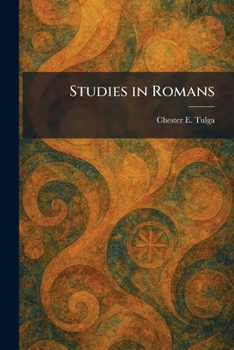
Studies in Romans

"Studies in Romans" offers a thorough and systematic exploration of the Apostle Paul's foundational epistle. Written with a deep reverence for the scriptural text, this work provides a thematic analysis designed to illuminate the profound theological truths contained within the Book of Romans. As one of the most influential writings in the Christian canon, Romans serves as a cornerstone for understanding the doctrines of salvation, sanctification, and the relationship between faith and the law.
In this volume, Chester E. Tulga guides readers through the complexities of Paul's logic, addressing key themes such as the universal need for redemption, the righteousness of God, and the practical implications of living a life transformed by the Gospel. Whether used for personal devotion, group Bible study, or academic research, "Studies in Romans" remains a valuable resource for anyone seeking a clearer grasp of the core tenets of the Christian faith. The work emphasizes the historical and spiritual context of the Roman church while drawing out timeless applications for the contemporary reader.
This work has been selected by scholars as being culturally important, and is part of the knowledge base of civilization as we know it. This work was reproduced from the original artifact, and remains as true to the original work as possible. Therefore, you may see the original copyright references, library stamps (as most of these works have been housed in our most important libraries around the world), and other notations in the work.
This work is in the public domain in the United States of America, and possibly other nations. Within the United States, you may freely copy and distribute this work, as no entity (individual or corporate) has a copyright on the body of the work.
As a reproduction of a historical artifact, this work may contain missing or blurred pages, poor pictures, errant marks, etc. Scholars believe, and we concur, that this work is important enough to be preserved, reproduced, and made generally available to the public. We appreciate your support of the preservation process, and thank you for being an important part of keeping this knowledge alive and relevant.
Customer Reviews
ThriftBooks ® and the ThriftBooks ® logo are registered trademarks of Thrift Books Global, LLC
