


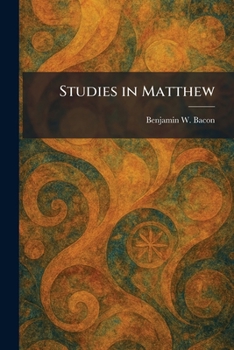
Studies in Matthew

Select Format
Select Condition 
Book Overview
"Studies in Matthew" is an influential and exhaustive examination of the First Gospel, authored by the renowned biblical scholar Benjamin W. Bacon. This work represents a significant milestone in New Testament criticism, focusing on the composition, structure, and theological aims of the Gospel of Matthew. Bacon employs rigorous historical-critical methods to explore the relationship between Matthew and the other Synoptic Gospels, particularly the Gospel of Mark and the hypothetical Q source.
The book is divided into several sections that delve into the literary structure of Matthew, analyzing how the author organized the teachings of Jesus into a framework suitable for the early Christian community. Bacon investigates the gospel's Jewish-Christian roots, its liturgical character, and its distinct portrayal of Jesus as a figure of new authority. Through meticulous analysis of the text's architecture, "Studies in Matthew" offers deep insights into the development of early Christian doctrine and the specific challenges faced by the community for which it was written.
Ideal for theologians, students of religion, and readers interested in the history of biblical interpretation, this work remains a cornerstone of 20th-century scholarship. It provides a comprehensive look at one of the most foundational texts in the Christian canon, illuminating the complexities of its origins and its enduring spiritual message.
This work has been selected by scholars as being culturally important, and is part of the knowledge base of civilization as we know it. This work was reproduced from the original artifact, and remains as true to the original work as possible. Therefore, you may see the original copyright references, library stamps (as most of these works have been housed in our most important libraries around the world), and other notations in the work.
This work is in the public domain in the United States of America, and possibly other nations. Within the United States, you may freely copy and distribute this work, as no entity (individual or corporate) has a copyright on the body of the work.
As a reproduction of a historical artifact, this work may contain missing or blurred pages, poor pictures, errant marks, etc. Scholars believe, and we concur, that this work is important enough to be preserved, reproduced, and made generally available to the public. We appreciate your support of the preservation process, and thank you for being an important part of keeping this knowledge alive and relevant.
Customer Reviews
ThriftBooks ® and the ThriftBooks ® logo are registered trademarks of Thrift Books Global, LLC
