


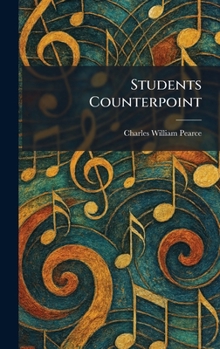
Students Counterpoint

"Students Counterpoint" by Charles William Pearce is a comprehensive and practical guide designed to introduce students to the intricate art of contrapuntal composition. As a foundational text in music theory, the work meticulously outlines the rules and principles of strict counterpoint, providing a structured approach to the study of polyphonic writing. Pearce, a renowned organist and educator, emphasizes the importance of voice-leading, melodic independence, and harmonic clarity, making complex musical concepts accessible to learners at various levels.
Throughout the volume, readers are guided through exercises and examples that illustrate the traditional species of counterpoint, fostering a deep understanding of the relationship between multiple independent musical lines. The book serves as an essential resource for aspiring composers, conductors, and theorists seeking to master the technical skills necessary for classical composition. By focusing on the discipline of formal structure and the aesthetic beauty of polyphony, "Students Counterpoint" remains a valuable tool for anyone dedicated to the study of Western musical heritage and the rigorous training of the musical ear.
This work has been selected by scholars as being culturally important, and is part of the knowledge base of civilization as we know it. This work was reproduced from the original artifact, and remains as true to the original work as possible. Therefore, you may see the original copyright references, library stamps (as most of these works have been housed in our most important libraries around the world), and other notations in the work.
This work is in the public domain in the United States of America, and possibly other nations. Within the United States, you may freely copy and distribute this work, as no entity (individual or corporate) has a copyright on the body of the work.
As a reproduction of a historical artifact, this work may contain missing or blurred pages, poor pictures, errant marks, etc. Scholars believe, and we concur, that this work is important enough to be preserved, reproduced, and made generally available to the public. We appreciate your support of the preservation process, and thank you for being an important part of keeping this knowledge alive and relevant.
Customer Reviews
ThriftBooks ® and the ThriftBooks ® logo are registered trademarks of Thrift Books Global, LLC
