


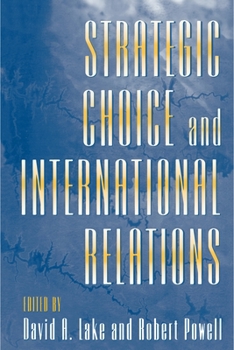
Strategic Choice and International Relations


Select Format
Select Condition 
Book Overview
The strategic-choice approach has a long pedigree in international relations. In an area often rent by competing methodologies, editors David A. Lake and Robert Powell take the best of accepted and contested knowledge among many theories. With the contributors to this volume, they offer a unifying perspective, which begins with a simple insight: students of international relations want to explain the choices actors make--whether these actors be states, parties, ethnic groups, companies, leaders, or individuals.
This synthesis offers three new benefits: first, the strategic interaction of actors is the unit of analysis, rather than particular states or policies; second, these interactions are now usefully organized into analytic schemes, on which conceptual experiments may be based; and third, a set of methodological "bets" is then made about the most productive ways to analyze the interactions. Together, these elements allow the pragmatic application of theories that may apply to a myriad of particular cases, such as individuals protesting environmental degradation, governments seeking to control nuclear weapons, or the United Nations attempting to mobilize member states for international peacekeeping. Besides the editors, the six contributors to this book, all distinguished scholars of international relations, are Jeffry A. Frieden, James D. Morrow, Ronald Rogowski, Peter Gourevitch, Miles Kahler, and Arthur A. Stein. Their work is an invaluable introduction for scholars and students of international relations, economists, and government decision-makers.Format:Paperback
Language:English
ISBN:0691026971
ISBN13:9780691026978
Release Date:July 1999
Publisher:Princeton University Press
Length:280 Pages
Weight:0.90 lbs.
Dimensions:0.9" x 6.0" x 9.0"
Customer Reviews
1 rating
A Better Explanation for Alliance Formation
Published by Thriftbooks.com User , 22 years ago
How does this book fare against the neorealist godfather? The "strategic choice" approach of Lake and Powell, unlike that of Waltz, is strongly predicated on methodological individualism and the importance of unit-level rationality, meaning that the preferences and strategies of individual actors are more important for Lake and Powell than for Waltz. Stein's chapter (in this book) calls for beginning with "purposive, intentionalist, rational explanations of behavior" (198) and then adding the component of actor interaction, in a bottom-up way. While Lake and Powell do try to cast themselves as agreeing with Waltz that "actors' intentions are not always a sufficient explanation for outcomes" (17), their game-theoretic, unit-level starting point necessarily privileges actors' intentions more than does Waltz's approach. On the topic of alliances, they take issue with Waltz's claim that balance-of-power politics necessarily prevails in all anarchic, self-help systems. Using game theory, Lake and Powell show that in repeated interactions, for any given division of benefits, "there exist strategies such that no actor has any incentive to deviate from its strategy" (24). These strategies do not entail balancing, because "it is in each actor's self-interest to participate in punishing a deviator" (24), as opposed to creating a new balance. From this formal insight from game theory, Lake and Powell conclude that Waltz has a problem of "inadequately specified microfoundations" (24). Because game theory tells us that Waltz's "causal chain from anarchy and the desire to survive to balancing behavior is incomplete" (24), Lake and Powell call for further analysis of the preferences and strategies of individual states - exactly the kind of approach that Waltz scorns as confusing process with system.Although it might confuse process with system, and/or go against the goal of parsimony, the strength of the strategic choice approach is that it can actually illuminate and process-trace why states assess their survival prospects and decide on one behavior or another. In other words, it can elaborate the relationship between system and outcomes in a more direct way than Waltz's theory. When Waltz writes that the system determines alliances, so that states' behavior (if they want to survive) is determined by the system, he seems to imply that states have the necessary information to know which choice is best, and that they will know which other choices will lead to defeat, and thus will not choose those paths and those alliances. But this is all implied. Waltz has no theory of individual strategizing because he claims that one is not necessary - the system does a better job of explaining outcomes. To put this claim to the test, the authors in the Lake and Powell volume attempt to unpack the unit-level strategizing that accompanies anarchy and alliances.The chapter by Morrow is a prime example of this unpacking. In looking at unit-level strategizing in the
Copyright © 2026 Thriftbooks.com
Terms of Use | Privacy Policy | Do Not Sell/Share My Personal Information | Cookie Policy | Cookie Preferences | Accessibility Statement
ThriftBooks ® and the ThriftBooks ® logo are registered trademarks of Thrift Books Global, LLC
ThriftBooks ® and the ThriftBooks ® logo are registered trademarks of Thrift Books Global, LLC
