


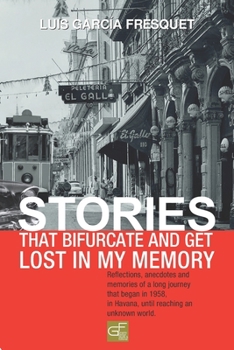
Stories that bifurcate and get lost in my memory
No Customer Reviews

For Stories that bifurcate and get lost in my memory, the author added writings published in his book Nostalgia: the opium of an exile. The book is divided into two parts: Stories and Nostalgias, which will show us two different stages of the author's career.
In Stories, the stories take place in Havana. In Nostalgia, already in exile, he addresses the events that occurred in Spain and Miami, and the generational contradictions of Cuban emigrants and exiles. All the writings in Stories are based on real events, recreated in different places, interweaving fiction, reality and imagination with the author's personal memories in times very far from the present. In this part of the book, time and space do not exist. Garc a Fresquet has always avoided telling us about his adventures and experiences within Cuban socialist journalism. Similarly, he avoided this in his book "Yo tambi n viv detr s de la cortinas de bagazo" (I also lived behind the bagasse curtain) (2021). Now, in Stories, he uses the resource of "bifurcating the stories" and Ignacio as a central character, who will appear in all the stories, sometimes narrating intrigues, mysteries of stolen jewels, confiscations, political contradictions, exile, or girls posing naked for a famous painter. In other parts, Ignacio is a teenage or adult character included in the stories. The writings in Nostalgia are very different from those in Stories. In this second part, the author completely distances himself from fiction and penetrates the reality of exile with his reflections and comments about the perception and vision of Cuba that each of the generations that have emigrated since 1959 have, without going into the details and the reasons they had for doing so. Written "without nostalgia for republican Cuba" because, according to the author, "it would fall into the trap of "that past that was better," which blinds and paralyzes you in times impossible to relive." The reflections and comments with added curiosities, are written in the first person without feeling the fear "of the edge of a scythe grazing your neck," as the author says. Garc a Fresquet has defined the content of the writings in Nostalg a in this way: "Six generations of Cubans have emigrated to the United States and other countries. Each of them brings with them their own homeland and nostalgias very different from each other. They carry the education they received, memories and very unequal customs. They arrive loaded with anecdotes and stories that differ greatly from the generations that preceded them, despite having a common origin. The new exiles and those who emigrate for economic reasons, have updated graphic images of their towns and of Havana. None of them bear any resemblance to those of the years before 1959." The author compares the perception of the trademark "Cuban nostalgia" that each of the generations that has emigrated since 1959 has, and differentiates it, without going into the details of the reasons they had for doing so. In addition, he highlights the loss of national identity when one emigrates. The curiosities and coincidences that arise from the themes themselves were added by the author to take us on a trip to the underworld of Havana. Before beginning to read, Luis Garc a Fresquet warns us that all "the writings are written like any literary enthusiast, in a simple and spontaneous way, without pretending to be a professional writer." The editor
In Stories, the stories take place in Havana. In Nostalgia, already in exile, he addresses the events that occurred in Spain and Miami, and the generational contradictions of Cuban emigrants and exiles. All the writings in Stories are based on real events, recreated in different places, interweaving fiction, reality and imagination with the author's personal memories in times very far from the present. In this part of the book, time and space do not exist. Garc a Fresquet has always avoided telling us about his adventures and experiences within Cuban socialist journalism. Similarly, he avoided this in his book "Yo tambi n viv detr s de la cortinas de bagazo" (I also lived behind the bagasse curtain) (2021). Now, in Stories, he uses the resource of "bifurcating the stories" and Ignacio as a central character, who will appear in all the stories, sometimes narrating intrigues, mysteries of stolen jewels, confiscations, political contradictions, exile, or girls posing naked for a famous painter. In other parts, Ignacio is a teenage or adult character included in the stories. The writings in Nostalgia are very different from those in Stories. In this second part, the author completely distances himself from fiction and penetrates the reality of exile with his reflections and comments about the perception and vision of Cuba that each of the generations that have emigrated since 1959 have, without going into the details and the reasons they had for doing so. Written "without nostalgia for republican Cuba" because, according to the author, "it would fall into the trap of "that past that was better," which blinds and paralyzes you in times impossible to relive." The reflections and comments with added curiosities, are written in the first person without feeling the fear "of the edge of a scythe grazing your neck," as the author says. Garc a Fresquet has defined the content of the writings in Nostalg a in this way: "Six generations of Cubans have emigrated to the United States and other countries. Each of them brings with them their own homeland and nostalgias very different from each other. They carry the education they received, memories and very unequal customs. They arrive loaded with anecdotes and stories that differ greatly from the generations that preceded them, despite having a common origin. The new exiles and those who emigrate for economic reasons, have updated graphic images of their towns and of Havana. None of them bear any resemblance to those of the years before 1959." The author compares the perception of the trademark "Cuban nostalgia" that each of the generations that has emigrated since 1959 has, and differentiates it, without going into the details of the reasons they had for doing so. In addition, he highlights the loss of national identity when one emigrates. The curiosities and coincidences that arise from the themes themselves were added by the author to take us on a trip to the underworld of Havana. Before beginning to read, Luis Garc a Fresquet warns us that all "the writings are written like any literary enthusiast, in a simple and spontaneous way, without pretending to be a professional writer." The editor
Format:Paperback
Language:English
ISBN:B0DRVVNPMD
ISBN13:9798304808668
Release Date:December 2024
Publisher:Independently published
Length:134 Pages
Weight:0.58 lbs.
Dimensions:9.0" x 0.3" x 6.0"
Customer Reviews
0 rating
Copyright © 2026 Thriftbooks.com
Terms of Use | Privacy Policy | Do Not Sell/Share My Personal Information | Cookie Notice | Cookie Preferences | Accessibility Statement
ThriftBooks ® and the ThriftBooks ® logo are registered trademarks of Thrift Books Global, LLC
ThriftBooks ® and the ThriftBooks ® logo are registered trademarks of Thrift Books Global, LLC
