


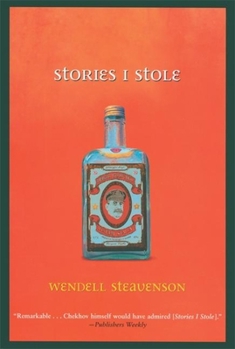
Stories I Stole from Georgia

Select Format
Select Condition 
Book Overview
Fed up with working for Time magazine in London, Steavenson moved to Georgia on a whim. Stories I Stole relates her time there in twenty vodka-fuelled episodes drawn from all over the country - tales of love, friendship and power cuts, of duelling (Georgian style), of horse races in the mountains, wars and refugees, broken hearts, fixed elections, drinking sessions and a room containing a thousand roses. Stories I Stole is a wonderful example of a writer tackling an unconventional subject with such wit, humanity and sheer literary verve that one is unable to imagine why one never learnt more about Georgia before. Stories I Stole is a magnificent first book: erudite, engaged, candid and blissfully poetic. PROLOGUE: The author visits a bizarre "Stalin theme park" culminating in the eery viewing of Stalin's death mask
SHASHLIK, TAMADA, SUPRA
The author visits Khaketi, where she is introduced to the tamada culture of "exaggerated hospitality; a point-of-honour hospitality." During a marathon toasting session at dinner she realizes "It is a kind of aggression. When they did not know you well, they filled your glass and filled it again and carefully watched how you drank it... This was the Georgian way, friend or enemy with nothing in between. History was lost in tradition, drinking a way of remembering and forgetting at the same time." SHUKI
The frustration of living with unpredictable power and water supplies during extremely cold winters; the heat and/or electricity is often turned off due to reasons ranging from sabotage, corruption, non-payment, theft, "black clan economics," and incompetence. Nevertheless this leads to a particular happiness when the light does come on. The author discovers the heavenly comfort of public baths. "Times were difficult; people had very little money. A lot of men were unemployed and all the old good professional jobs, teachers, nurses, police, engineers, were state jobs and paid less than $50 a month... Half Tbilisi owed the other half money." ETHNIC CLEANSING
The author visits Abkhazia, where a refugee has asked her to find the apartment that war caused him to flee. She finds a woman living there who is a refugee herself--after her own house was burned down, she discovered the fully furnished house in Abkhazia shortly after it was vacated, and has been living there ever since, proudly tending the garden of the previous occupant. WHO ARE THE ABKHAZ
On the beach with Shalva, whom she suspects is "Abkhaz KGB." He feeds her the party line about the Abkhaz occupation and she feels like screaming truths at him. "You won the war. You threw out all the Georgians. You have your homeland to yourselves (apart from the Armenian villages and the pockets of Russians) and what is this place? It's a black hole. There are barely any cars, barely any petrol, no factories, nothing works, no private businesses, a curfew, no salaries, barely any pensions, a shell of a university, a terrible hospital, etc. etc." But Shalva doubts that the West is paradise: "Here we have everything we need. The land is fertile." THE DUEL
The story of Dato and Aleko--they get into a car wreck and Dato's face is horribly scarred. Aleko steals Dato's wife and Dato challenges him to a fight. When Aleko beats Dato up, Dato pulls a gun and shoots the man until he is almost paralyzed. Dato, meanwhile, lives the rest of his life with his mother, hooked on heroin. "Not really Pushkin is it?" LARGE ABANDONED OBJECTS
The author drives to Abkhazia with several journalists to see incumbent Ardzinba win the presidential election (the journalists rename it the "presidential farce," since Ardzinba is the only one running. The author marvels over the abandoned relics of the USSR she sees along the roadside--rusting tractors, bits of pipli
SHASHLIK, TAMADA, SUPRA
The author visits Khaketi, where she is introduced to the tamada culture of "exaggerated hospitality; a point-of-honour hospitality." During a marathon toasting session at dinner she realizes "It is a kind of aggression. When they did not know you well, they filled your glass and filled it again and carefully watched how you drank it... This was the Georgian way, friend or enemy with nothing in between. History was lost in tradition, drinking a way of remembering and forgetting at the same time." SHUKI
The frustration of living with unpredictable power and water supplies during extremely cold winters; the heat and/or electricity is often turned off due to reasons ranging from sabotage, corruption, non-payment, theft, "black clan economics," and incompetence. Nevertheless this leads to a particular happiness when the light does come on. The author discovers the heavenly comfort of public baths. "Times were difficult; people had very little money. A lot of men were unemployed and all the old good professional jobs, teachers, nurses, police, engineers, were state jobs and paid less than $50 a month... Half Tbilisi owed the other half money." ETHNIC CLEANSING
The author visits Abkhazia, where a refugee has asked her to find the apartment that war caused him to flee. She finds a woman living there who is a refugee herself--after her own house was burned down, she discovered the fully furnished house in Abkhazia shortly after it was vacated, and has been living there ever since, proudly tending the garden of the previous occupant. WHO ARE THE ABKHAZ
On the beach with Shalva, whom she suspects is "Abkhaz KGB." He feeds her the party line about the Abkhaz occupation and she feels like screaming truths at him. "You won the war. You threw out all the Georgians. You have your homeland to yourselves (apart from the Armenian villages and the pockets of Russians) and what is this place? It's a black hole. There are barely any cars, barely any petrol, no factories, nothing works, no private businesses, a curfew, no salaries, barely any pensions, a shell of a university, a terrible hospital, etc. etc." But Shalva doubts that the West is paradise: "Here we have everything we need. The land is fertile." THE DUEL
The story of Dato and Aleko--they get into a car wreck and Dato's face is horribly scarred. Aleko steals Dato's wife and Dato challenges him to a fight. When Aleko beats Dato up, Dato pulls a gun and shoots the man until he is almost paralyzed. Dato, meanwhile, lives the rest of his life with his mother, hooked on heroin. "Not really Pushkin is it?" LARGE ABANDONED OBJECTS
The author drives to Abkhazia with several journalists to see incumbent Ardzinba win the presidential election (the journalists rename it the "presidential farce," since Ardzinba is the only one running. The author marvels over the abandoned relics of the USSR she sees along the roadside--rusting tractors, bits of pipli
Format:Paperback
Language:English
ISBN:080214067X
ISBN13:9780802140678
Release Date:February 2004
Publisher:Grove Press
Length:277 Pages
Weight:0.98 lbs.
Dimensions:0.7" x 5.5" x 8.2"
Customer Reviews
5 ratings
Brilliant work: Don't miss it !!
Published by Thriftbooks.com User , 20 years ago
This impressive debut works on too many levels to winnow down to a brief review. Ms. Steavenson reminds me a bit of Isaac Bashevis Singer as she brings us into worlds we generally know only through newspaper and television reports. Her attention to detail and her encapsulations of characters and situations and the bigger picture are masterful, particularly at such a relatively young age. She knows what to leave out, so that what's powerful remains. Unlike some reviewers below, I thought the elements she included about her personal life were arresting and completely integrated. Extremely high recommendation for a work that also has the bonus features of a decent map, a glossary of ethnic groups, and background reading for those who want to pursue related works.
I loved this book.
Published by Thriftbooks.com User , 21 years ago
Knowing virtually nothing of the Caucasus I felt a little overwhelmed at first; but Steavenson quickly won me over with her absorbing writing and storytelling. I felt like I was right there with her. She has an incredible insight into human nature. I can't wait to read it over again, and expect to like it even better the second time around.
A wonderful achievement
Published by Thriftbooks.com User , 22 years ago
This is an absolutely delightful book, both for people who have been to the Caucasus and to those who simply want to read an enchanting fusion of attentive observation and personal reflection. In some ways I think this book even should find its way onto reading lists of university courses on this region, because it is so rich in rendering the texture of life in Georgia, its metaphysical quality. The former Soviet Union can be a profound shock. The typical western mindset is to improve, to think of solutions, to think "if only they started to...". This makes much writing about the personal experiences in the former Soviet Union (and, in particular, the Caucasus) into a report from a narrow frontline of friction between incompatible perspectives. Wendell Steavenson is much more sophisticated, suspending the typical perspective, allowing her a fuller, more comprehensive account.You will definitely enjoy the book.
Georgian adventures
Published by Thriftbooks.com User , 22 years ago
I felt like I was right there with her seeing what she saw, drinking all that alcohol, and having adventures in Georgia! this book gives you an idea of how Georgian people really are.
Brilliant Taste of Post-Soviet Life
Published by Thriftbooks.com User , 22 years ago
Former Time magazine writer Steavenson hits upon a nice variation to the armchair travel genre with this wonderful little book on the former Soviet Republic of Georgia. Rather than trying to systematically detail the small country's tangled web of ethnicities and chaotic recent history, she recounts her time there through twenty chapters/stories. These loosely connected and loosely chronological stories provide a remarkably nuanced portrait of a country where nothing works, government seems largely irrelevant, and the people are remarkable. Weaving in many of her own friendships and a relationship with a photojournalist, she covers rigged elections, ethnic tensions, the nearby war in Chechnya, and mainly daily life with remarkable sensitivity. The nice thing is that she doesn't do so with the usual world-weariness of the foreign corespondent, but with a depth of feeling that never falls into sentimentalism or condescension It's a curiously individual work in that there's no real reason for her to be there, there is no larger theme she hangs her stories on, and no gimmicks. Just honest stories about a country where a strange civil war and two secessionist wars over the last decade have utterly destroyed the economy and left the country with little hope. A definite must read for anyone interested in the Caucuses or the fate of post-Soviet republics.
Copyright © 2026 Thriftbooks.com Terms of Use
| Privacy Policy | Do Not
Sell/Share My Personal Information | Cookie Policy | Cookie Preferences | Accessibility Statement
ThriftBooks® and the ThriftBooks® logo are registered trademarks of Thrift Books Global, LLC
ThriftBooks® and the ThriftBooks® logo are registered trademarks of Thrift Books Global, LLC
