


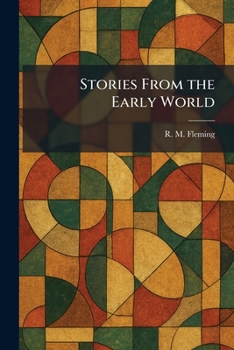
Stories From the Early World

"Stories From the Early World" is a captivating and comprehensive collection of myths, legends, and traditional folk tales gathered from diverse cultures and ancient civilizations across the globe. This work serves as an exploration of the foundational narratives that shaped early human understanding of the natural world, societal structures, and moral frameworks.
The collection spans a vast geographic and cultural range, presenting stories from Egypt, Babylon, China, and various indigenous groups. Each narrative is presented with an emphasis on its historical and anthropological significance, illustrating how different peoples interpreted the mysteries of existence through the power of the spoken and written word. R. M. Fleming provides a bridge between ancient oral traditions and modern readers, maintaining the evocative spirit of the original tales while making them accessible for educational and leisure reading.
Ideal for those interested in folklore, ancient history, and the evolution of human culture, "Stories From the Early World" highlights the universal themes of heroism, creation, and the human condition. It remains an essential resource for understanding the narrative roots of modern society and the enduring power of storytelling throughout history.
This work has been selected by scholars as being culturally important, and is part of the knowledge base of civilization as we know it. This work was reproduced from the original artifact, and remains as true to the original work as possible. Therefore, you may see the original copyright references, library stamps (as most of these works have been housed in our most important libraries around the world), and other notations in the work.
This work is in the public domain in the United States of America, and possibly other nations. Within the United States, you may freely copy and distribute this work, as no entity (individual or corporate) has a copyright on the body of the work.
As a reproduction of a historical artifact, this work may contain missing or blurred pages, poor pictures, errant marks, etc. Scholars believe, and we concur, that this work is important enough to be preserved, reproduced, and made generally available to the public. We appreciate your support of the preservation process, and thank you for being an important part of keeping this knowledge alive and relevant.
Customer Reviews
ThriftBooks ® and the ThriftBooks ® logo are registered trademarks of Thrift Books Global, LLC
