


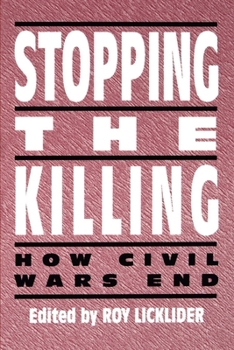
Stopping the Killing: How Civil Wars End

Select Format
Select Condition 
Book Overview
Yugoslavia, Rwanda, Liberia, Somalia, Azerbaijan, El Salvador, Northern Ireland, Lebanon, Cambodia -- all provide bloody evidence that civil wars continue to have a powerful impact on the international scene. Because they tear at the very fabric of a society and pit countryman against countryman, civil wars are often the most brutal and difficult to extinguish -- witness the American Revolution.
And yet, civil wars do inevitably end. England is no longer criss-crossed by warring armies representing York and Lancaster or King and Parliament. The French no longer kill one another over the divine right of kings. Argentines seem reconciled to living in a single state, rather than several. The ideologies of the Spanish Civil War now seem largely irrelevant. And the possibility of Southern secession is an issue long-buried in the American past.
The question then begs itself: how do people who have been killing one another with considerable enthusiasm and success come together to form a common government? How can individuals and factions work together, politically and economically, with others who have killed their friends, parents, children and lovers? How are armed societies disarmed? What effect does a total military victory have on a lasting peace? In sum, how are civil societies constructed from civil violence and chaos? This is the central concern of Stopping the Killing.
In this highly original and much needed volume, a distinguished group of experts on civil wars discuss both specific conflicts and broader theoretical issues. Individual chapters examine civil wars in Colombia, the Sudan, Yemen, America, Greece, and Nigeria, and analyze the causes of peace, the relationship between the battlefield and the negotiating table, and issues of settlement. An introduction and conclusion by the editor unify the volume. Contributors include: Jonathan Hartlyn (Univ. of North Carolina), Caroline Hartzell (Univ. of California, Davis), Jane E. Holl (U.S. Military Academy), John Iatrides (Southern Connecticut State University), James O'Connell (University of Bradford), Donald Rothchild (Univ. of California, Davis), Stephen John Stedman (Johns Hopkins Univ.), Robert Harrison Wagner (Univ. of Texas, Austin), Harvey Waterman (Rutgers Univ.), Manfred Wenner (Northern Illinois Univ.), and I. William Zartman (Johns Hopkins Univ.).
Customer Reviews
The Best
ThriftBooks ® and the ThriftBooks ® logo are registered trademarks of Thrift Books Global, LLC
