


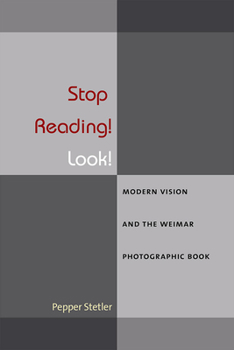
Stop Reading! Look!: Modern Vision and the Weimar Photographic Book
No Customer Reviews

In the second half of the Weimar period (1918-33), photographers produced books consisting almost entirely of sequenced images. The subjects ranged widely: from plants and nature to the modern metropolis, from exotic cultures to the German Volk, from anonymous workers to historical figures. While many of the books were created by key practitioners and theorists of modern photography, scholars have rarely addressed the significance of the book format to modern conceptions of photographic meaning. The term "photo-essay" implies that these photographic books were equivalent to literary endeavors, created by replacing text with images, but such assumptions fail to explore the motivations of the books' makers.
Stop Reading Look argues that Weimar photographic books stood at the center of debates about photography's ability to provide uniquely visual forms of perception and cognition that exceed the capacity of the textual realm. Each chapter provides a sustained analysis of a photographic book, while also bringing the cultural, social, and political context of the Weimar Republic to bear on its relevance and meaning.
Stop Reading Look argues that Weimar photographic books stood at the center of debates about photography's ability to provide uniquely visual forms of perception and cognition that exceed the capacity of the textual realm. Each chapter provides a sustained analysis of a photographic book, while also bringing the cultural, social, and political context of the Weimar Republic to bear on its relevance and meaning.
Format:Hardcover
Language:English
ISBN:0472119664
ISBN13:9780472119660
Release Date:December 2015
Publisher:University of Michigan Press
Length:264 Pages
Weight:1.82 lbs.
Dimensions:0.8" x 7.0" x 10.1"
Customer Reviews
0 rating
Copyright © 2026 Thriftbooks.com Terms of Use
| Privacy Policy | Do Not
Sell/Share My Personal Information | Cookie Policy | Cookie Preferences | Accessibility Statement
ThriftBooks® and the ThriftBooks® logo are registered trademarks of Thrift Books Global, LLC
ThriftBooks® and the ThriftBooks® logo are registered trademarks of Thrift Books Global, LLC
