


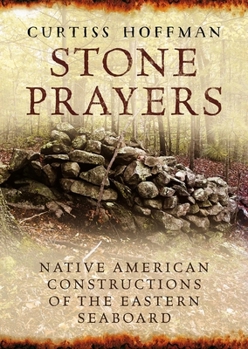
Stone Prayers: Native American Stone Contructions of the Eastern Seaboard
No Customer Reviews

Examines the debate surrounding ancient stone monuments on the eastern seaboard, supporting the indigenous construction hypothesis with scientific data from over 5,500 sites.
Scattered throughout the woodlands and fields of the eastern seaboard of the United States and Canada are tens of thousands of stone monuments. These stone constructions have been the subject of debate among archaeologists and antiquarians for the past seventy-five years. Prominent among the competing hypotheses have been the allegations that all of these structures were built by colonial farmers removing rocks from their fields; or that they were built by pre-Columbian transatlantic voyagers; or that they are the result of natural deposition by glaciers or downslope erosion; or that they were constructed as sacred places by the indigenous peoples of the region. The latter hypothesis has gained significant attention over the past decade, as the result of strong and vocal support from the regional descendant indigenous communities for the preservation of these monuments, called by them "stone prayers," from encroachment and desecration by development interests. The purpose of this book is to provide quantitative support for the indigenous construction hypothesis, by providing a framework firmly and explicitly situated in the scientific method to test the four hypotheses above against a robust set of data - a total of 5,550 sites from the entire region.
Scattered throughout the woodlands and fields of the eastern seaboard of the United States and Canada are tens of thousands of stone monuments. These stone constructions have been the subject of debate among archaeologists and antiquarians for the past seventy-five years. Prominent among the competing hypotheses have been the allegations that all of these structures were built by colonial farmers removing rocks from their fields; or that they were built by pre-Columbian transatlantic voyagers; or that they are the result of natural deposition by glaciers or downslope erosion; or that they were constructed as sacred places by the indigenous peoples of the region. The latter hypothesis has gained significant attention over the past decade, as the result of strong and vocal support from the regional descendant indigenous communities for the preservation of these monuments, called by them "stone prayers," from encroachment and desecration by development interests. The purpose of this book is to provide quantitative support for the indigenous construction hypothesis, by providing a framework firmly and explicitly situated in the scientific method to test the four hypotheses above against a robust set of data - a total of 5,550 sites from the entire region.
Format:Paperback
Language:English
ISBN:1634990498
ISBN13:9781634990493
Release Date:February 2019
Publisher:America Through Time
Length:320 Pages
Weight:1.85 lbs.
Dimensions:0.8" x 6.7" x 9.7"
Customer Reviews
0 rating
Copyright © 2026 Thriftbooks.com Terms of Use
| Privacy Policy | Do Not
Sell/Share My Personal Information | Cookie Policy | Cookie Preferences | Accessibility Statement
ThriftBooks® and the ThriftBooks® logo are registered trademarks of Thrift Books Global, LLC
ThriftBooks® and the ThriftBooks® logo are registered trademarks of Thrift Books Global, LLC
