


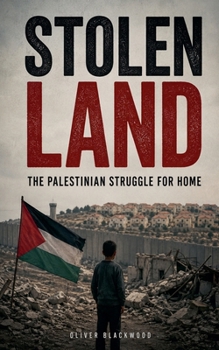
Stolen Land The Palestinian Struggle for Home

Land is more than territory. It is home, identity, history and belonging. For generations of Palestinians, however, the struggle to remain on their land has been shaped by displacement, occupation, settlement expansion and an increasingly uncertain future.
Stolen Land: The Palestinian Struggle for Home examines the Israeli-Palestinian conflict through the experiences of the Palestinian people and their continuing fight for dignity, justice and the right to live freely in their homeland. Beginning with the towns, villages and communities that existed before the establishment of Israel, the book traces the historical events that transformed Palestine and changed the lives of millions.
The book explores the rise of political Zionism, British rule in Palestine, the Balfour Declaration and the competing national movements that emerged during the early twentieth century. It considers the events surrounding the creation of Israel in 1948 and the Nakba, during which hundreds of thousands of Palestinians fled or were expelled from their homes. It also examines how refugee camps, lost villages and inherited memories of displacement became central to Palestinian identity.
Moving from the past into the present, Stolen Land investigates the occupation of the West Bank, the annexation of East Jerusalem, the expansion of Israeli settlements and the restrictions that shape daily Palestinian life. It considers checkpoints, military raids, home demolitions, land confiscation, settler violence and the separation barrier, showing how political decisions affect ordinary families, farmers, workers and children.
The book also looks at Gaza and the consequences of blockade, repeated wars and widespread destruction. It explores the humanitarian cost of the conflict while recognising the suffering of civilians and rejecting attacks against innocent people, regardless of their identity. Particular attention is given to the devastating consequences faced by Palestinians and the international community's response to their displacement and loss.
Beyond the physical struggle for territory, this book considers the battle over history, language and public memory. Why do Israelis and Palestinians often tell such different stories about the same land? How have words such as "occupation," "security," "terrorism," "resistance" and "self-defence" shaped international understanding? And why has a lasting political settlement remained so difficult to achieve?
The role of the United States, Britain, Europe, the United Nations and Arab governments is examined alongside failed negotiations and competing proposals for peace. From the Oslo Accords to the continuing debate over one-state and two-state solutions, the book asks whether diplomacy can succeed while settlement expansion and displacement continue.
Written in an accessible and strongly critical style, Stolen Land focuses on systems, institutions and political decisions rather than blaming entire religious or ethnic communities. It distinguishes between Judaism and Zionism, between Israeli citizens and the actions of the Israeli government, and between legitimate criticism of state policy and prejudice against Jewish people. This distinction is essential to any fair and responsible discussion of the conflict.
This is not simply a book about borders or distant political arguments. It is about families who carry the keys to homes they can no longer enter, communities struggling to remain on their land and a people determined not to allow their identity or history to disappear.
Stolen Land: The Palestinian Struggle for Home offers readers a direct and thought-provoking introduction to one of the world's longest and most controversial conflicts. It invites them to look beyond headlines, confront difficult historical realities and understand why the Palestinian demand for home, freedom and justice continues.
Customer Reviews
ThriftBooks ® and the ThriftBooks ® logo are registered trademarks of Thrift Books Global, LLC
