


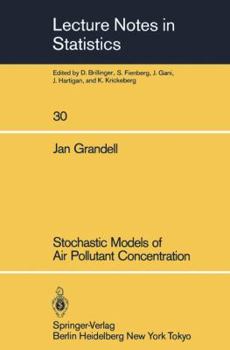
Stochastic Models of Air Pollutant Concentration
No Customer Reviews

About fifteen years ago Henning Rodhe and I disscussed the calculation of residence times, or lifetimes, of certain air pollutants for the first time. He was interested in pollutants which were mainly removed from the atmosphere by precipitation scavenging. His idea was to base the calculation on statistical models for the variation of the precipitation i~tensity and not only on the average precipitation intensity. In order to illustrate the importance of taking the variation into account we considered a simple model - here called the Markov model - for the precipitation intensity and computed the distribution of the residence time of an aerosol particle. Our expression for the average residence time - here formula (13- was rather much used by meteorologists. Certainly we were pleased, but while our ambition had been to provide an illustration, our work was merely understood as a proposal for a realistic model. Therefore we found it natural to search for more general models. The mathematical problems involved were the origin of my interest in this field. A brief outline of the background, purpose and content of this paper is given in section 1. It is a pleasure to thank Gunnar Englund, Georg Lindgren, Henning Rodhe and Michael Stein for their substantial help in the pre? paration of this paper and Iren Patricius for her assistance in typing.
Format:Paperback
Language:English
ISBN:0387961976
ISBN13:9780387961972
Release Date:October 1985
Publisher:Springer
Length:120 Pages
Weight:0.39 lbs.
Dimensions:0.3" x 6.1" x 9.2"
Related Subjects
Engineering Gardening Gardening & Landscaping Math Mathematics Science & Math TechnologyCustomer Reviews
0 rating
Copyright © 2026 Thriftbooks.com Terms of Use
| Privacy Policy | Do Not
Sell/Share My Personal Information | Cookie Policy | Cookie Preferences | Accessibility Statement
ThriftBooks® and the ThriftBooks® logo are registered trademarks of Thrift Books Global, LLC
ThriftBooks® and the ThriftBooks® logo are registered trademarks of Thrift Books Global, LLC
