


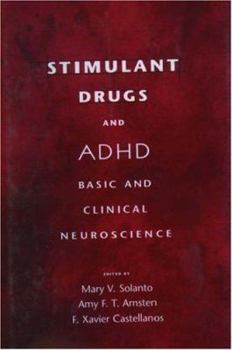
Stimulant Drugs and ADHD: Basic and Clinical Neuroscience

Select Format
Select Condition 
Book Overview
Stimulant drugs are widely used in the treatment of ADHD in children and adults. Hundreds of studies over the past 60 years have demonstrated their effectiveness in improving attention span, increasing impulse control, and reducing hyperactivity and restlessness. Despite widespread interest in these compounds, however, their mechanisms of action in the central nervous system have remained poorly understood. Recent advances in the basic and clinical neurosciences now afford the possibility of elucidating these mechanisms. The current volume is the first to bring this expanding knowledge to bear on the central question of why and how stimulants exert their therapeutic effects. The result is a careful, comprehensive, and insightful integration of material by well-known scientists that significantly advances our understanding of stimulant effects and charts a course for future research. Part I presents a comprehensive description of the clinical features of ADHD and the clinical response to stimulants. Part II details the cortical and subcortical neuroanatomy and functional neurophysiology of dopamine and norepinephrine systems with respect to the regulation of attention, arousal, activity, and impulse control and the effects of stimulants on these systems. Part III is devoted to clinical research, including recent studies of neuroimaging, genetics, pharmacodynamic and pharmacokinetic properties of stimulants, effects on cognitive functions, neurophysiological effects in humans with and without ADHD and in non-human primates, and comparison of stimulants and non-stimulants in the treatment of ADHD. Part IV is a masterful synthesis that presents alternative models of stimulant drug action and generates key hypotheses for continued research. The volume will be of keen interest to researchers and clinicians in psychiatry, psychology, and neurology, neuroscientists studying stimulants, and those pursuing development of new drugs to treat ADHD.
Format:Hardcover
Language:English
ISBN:0195133714
ISBN13:9780195133714
Release Date:January 2001
Publisher:Oxford University Press
Length:424 Pages
Weight:1.58 lbs.
Dimensions:1.1" x 6.4" x 9.4"
Customer Reviews
1 rating
Very fine technical work.
Published by Thriftbooks.com User , 24 years ago
This is an important technical work for anyone concerned with Attention Deficit Disorder. While not ideal for those without advanced degrees, parents and adults in an ADHD system may find it worth their while to work through the highly specialized language. The articles assess from different scientific perspectives the trajectory of stimulant medication. While priced very fairly given its highly technical content, ADHD support groups maybe able to share the cost and the book. Members within the group could select a chapter, and then present it to their group. Most of the articles contain at least a few sections that will be understandable to non-scientists. Such a process could improve physician patient communication about the medication. Detractors of stimulant medication have to come to grips with the enormous relief that these medications provide for adults and children. While the specific locations and dynamics of the epenephrine and dopamine interactions remain shrouded, the clinical evidence overwhelming attested to the efficacy of stimulant medication. Until detractors can produce similar empirical data, resources have to be allocated to treatments that actually work. The book's purpose is to bring together the best and most current data available as a way of supporting and furthering pharmaceutical research. In this purpose the editor's and contributor's reveals science at its best, methodically navigating a dense forest of dimly understood variables in an attempt to relieve human suffering and push back the boundaries of ignorance. They echo our ancestors who learned to harness fire.
Copyright © 2026 Thriftbooks.com Terms of Use
| Privacy Policy | Do Not
Sell/Share My Personal Information | Cookie Policy | Cookie Preferences | Accessibility Statement
ThriftBooks® and the ThriftBooks® logo are registered trademarks of Thrift Books Global, LLC
ThriftBooks® and the ThriftBooks® logo are registered trademarks of Thrift Books Global, LLC
