


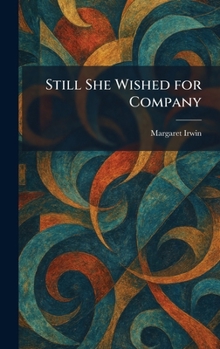
Still She Wished for Company

"Still She Wished for Company" is a captivating time-slip novel that masterfully weaves together the lives of two women separated by centuries. Set in both the 18th century and the 1920s, the narrative explores the mysterious connection between Juliana, a young woman trapped in the social constraints of the Georgian era, and Jan, a modern woman working in London.
Through a series of uncanny encounters and shared sensations, Margaret Irwin crafts a haunting exploration of loneliness, desire, and the thin veil between the past and the present. As the two storylines converge, the novel transcends the traditional ghost story, offering a profound psychological study of its protagonists. Irwin's evocative prose brings the historical settings to life while maintaining a sense of ethereal suspense.
"Still She Wished for Company" remains a celebrated work of supernatural fiction, praised for its innovative structure and its poignant depiction of the human longing for connection across the boundaries of time. Readers of classic gothic literature and historical fantasy will find this work both chilling and deeply moving.
This work has been selected by scholars as being culturally important, and is part of the knowledge base of civilization as we know it. This work was reproduced from the original artifact, and remains as true to the original work as possible. Therefore, you may see the original copyright references, library stamps (as most of these works have been housed in our most important libraries around the world), and other notations in the work.
This work is in the public domain in the United States of America, and possibly other nations. Within the United States, you may freely copy and distribute this work, as no entity (individual or corporate) has a copyright on the body of the work.
As a reproduction of a historical artifact, this work may contain missing or blurred pages, poor pictures, errant marks, etc. Scholars believe, and we concur, that this work is important enough to be preserved, reproduced, and made generally available to the public. We appreciate your support of the preservation process, and thank you for being an important part of keeping this knowledge alive and relevant.
Customer Reviews
ThriftBooks ® and the ThriftBooks ® logo are registered trademarks of Thrift Books Global, LLC
