


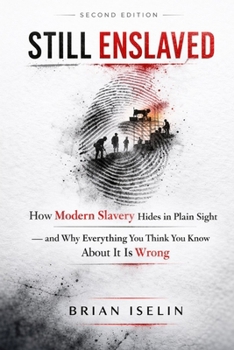
Still Enslaved

Why do fifty million people remain enslaved in the modern world - and why can't we see them?
The answer isn't ignorance. The information has been available for thirty years. The answer is something more precisely constructed: a set of stories - six of them - that process the reality of modern slavery in ways that discharge moral discomfort without requiring any change in behaviour.
Still Enslaved identifies those stories. Then it dismantles them.
The Six Myths This Book Demolishes:
keep all six myth paragraphs unchanged - they're already accurate]
Drawing on twenty-five years of counter-slavery investigation - including operational field experience across multiple regions and advisory work with the United Nations - Brian Iselin writes with the authority of someone who has sat in the rooms this book describes. The domestic worker in the Gulf whose passport is in a desk drawer she cannot open. The construction worker in the heat who hasn't been paid in two months and, when asked why he stays, says simply: Where to go? I owe. The teenager in a European city who doesn't know what country she is in.
These are not rhetorical devices. They are the unit of analysis the human brain can actually process - the specific, textured reality behind the number fifty million that the brain cannot feel.
The book also goes where most accounts will not: into the silence between victims and the systems built to identify them. Why testimony fails at the precise moment the architecture is supposed to detect captivity. What the people inside know but cannot say. What the question "do you have any problems?" actually asks of someone whose family has borrowed to fund their journey, whose accommodation is tied to the same network as their work, and whose only protection is the relationship that is exploiting them.
Still Enslaved moves between the room and the system, between the individual and the structural force that put them there, because neither alone is sufficient. The room without the system is a tragedy. The system without the room is a policy paper. Together, they constitute the thing that demands a response.
Customer Reviews
ThriftBooks ® and the ThriftBooks ® logo are registered trademarks of Thrift Books Global, LLC
