


Stephen Roach on the Next Asia: Opportunities and Challenges for a New Globalization


Select Format
Select Condition 
Book Overview
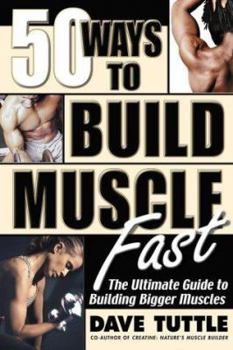
Are you almost getting what you want out of your workouts, but you're not sure how to reach the next "level"? Whether you are a competitive bodybuilder or you work out just to shape up, professional health writer and bodybuilder Dave Tuttle can help you reach that next level with 50 Ways to Build Muscle Fast. With 50 Ways to Build Muscle Fast you will learn the latest proven strategies and secrets to building a superior physique. This book will provide you with helpful answers to the most common questions about bodybuilding. The recommendations you will find in this unique book build upon one another, creating mental and physical synergies that will allow you to achieve the greatest improvements in your physique. And when all of your energies are focused in the same direction, you will find that you can enjoy more strength, more lean muscle, and more effective workouts than you ever dreamed possible.
Format:Hardcover
Language:English
ISBN:0895299518
ISBN13:9780895299512
Release Date:September 2009
Publisher:Wiley
Length:432 Pages
Weight:0.90 lbs.
Dimensions:9.3" x 1.3" x 6.2"
Age Range:18 years and up
Grade Range:Grade 12 and higher
Customer Reviews
4 ratings
Roach Sees The Writing On The Wall
Published by Thriftbooks.com User , 15 years ago
Stephen Roach is a kind of pide piper. He is stating the plain truth for American ears, "an important shift in the gravity of global economic power from the West to the East could well be at hand." Investors whom want to have money with purchasing power in 5 years had better be listening now.
good commentary
Published by Thriftbooks.com User , 16 years ago
Roach is correct in his analysis and recomendations but since the book is a collection of his written commentary, it is somewhat repetitive. Good summary at the beginning of each chapter - speed read the rest.
insightful collection of Stephen Roach's consistent views
Published by Thriftbooks.com User , 16 years ago
This collection of essays has been collected over the years and aggregated into 5 chapters, each containing a subset of the essays associated with the themes. The heart of the book focuses on the global imbalances, the causes, effects and the risks, both political as well as economic that have evolved and need to be dealt with in a coordinated systematic manner. Much of the literature focuses on several major themes, 1- people cant globalize and decouple, they must be either or. 2 - the trading relationships that have emerged are inherintly unstable. 3 - the instability can be fixed but requires us to look from above at the problem in much greater degree than politicians tend to when they voice local constituencies. The major focus on the imbalance is on the American consumption side and their gross overconsumption to an unheard of degree. To be precise Stephen Roach talks in depth about the change in economic landscape such that the previous arena of non-tradeable goods have morphed into tradeable, in particular services, due to the internet etc (similar in spirit to freedman's world is flat ideas). The result of this is that there has been wage pressure on developed nations that have created a downward drift barely less than productivity growth such that real wage growth has lagged substantially the growth it would have recieved in a theoretical closed economy. The repurcussions are both backlash at owners of capital who have increased their share of business revenues due to increased bargaining power within the firm due to the more open global labor market. This is both backlash to the distribution of wealth as well as global trade perspectives and the search for a scapegoat (ie providers of the replacement labor in places like china and india). The most of the book focuses on the themes of global imbalances and speaks about China's savings glut (it has had the lowest consumption proportion of GDP and GDP growth in history) and its export dominated model to fuel growth. This is articulated as unsustainable and more importantly unstable due to unstable demand (as its abroad). The currency issue of RMB is discussed as a problem that should not be focused on, as the trade deficit is multi-lateral and is quite "obvious" scapegoating from Stephen's perspective. The US economy is on the recieving end of an even more critical analysis. It has become an asset dependent country who is growing by importing savings, and pretty much only growing by consumption. Its savings went to negative and it needs to start investing in its future as equitizing capital gains for consumption is not a source of growth. Clearly looking at the time stamps of the essay, stephen called the bubbles forming correctly, among most of the skeptics, no one saw the magnitude coming, but those were also a product of financial feedbacks and bank run dynamics which are not the subject of his analysis. Given that, one should pay attention to him as he saw through the
Good Insights and Data -
Published by Thriftbooks.com User , 16 years ago
The book is a collection of essays written by Roach over the past three years reporting how the Asia story has played out to date, and how it looks for the future. Most of the book focuses on China, providing a wealth of background for understanding Roach's recommendations for the U.S. and China, and the direction of China's leadership. Nearly 80% of China's GDP goes to exports (30%) and fixed investment (50%). Since the early 1990s its per-capita income has increased 5X+. America accounts for about 4.5% of the world's population and about $10 trillion of spending in 2008; China and India together account for 40% of population and only $2.5 trillion on spending. America's economy has grown nearly 4%/year in real consumer demand over the past 15 years - 3X the growth in Japan and Europe. Seventy-two percent of the U.S. GDP in 2007 was consumer spending (a record), falling only to 71% currently. China's leadership recognizes the need to reduce reliance on exports - partly because of the sagging U.S. and world economies, and partly to reduce the likelihood and severity of any anti-China trade actions by the U.S. Congress (45 such bills were introduced in the U.S. Congress between 2005-07). Other challenges include improving resource consumption efficiencies (eg. cutting oil consumption per unit of GDP by 4%/year - now 2X that of the world average), as well as reducing pollution and environmental degradation. (China's carbon emissions per person are less than 10% that of the U.S.) China's high savings rate (50% in 2005, with 65% believing that their savings are too low) is traceable two factors - the first is massive layoffs via 15 years of reforming state-owned enterprises (SOEs - now 30-40% of the economy) that involved 60 million layoffs from 1997, and continuing reductions of 2 million/year. The second is the lack of an institutionalized safety net. (India's savings rate is in the high 30 percent range.) American writers sometimes allege that Chinese labor costs will soon begin a rapid climb, damping increased exports. Roach, however, points out that even after six years of double-digit increases, average hourly compensation for Chinese manufacturing workers was only 3% that of the U.S. average in 2004. Meanwhile, productivity in its industrial sector surged nearly 20%/year from 2000-2004. Finally, its 745 million rural population is by far the largest pool of surplus labor in the world; there also have been 20 million layoffs in Guaydong Province resulting from the export slowdown. Obviously the Chinese leadership is not concerned about a possible shortage of labor, else its latest Five-Year Plan would not have emphasized expansion of labor-intensive services. Private consumption in China accounts for only about 35% of its GDP, trending downwards from 65% in 1952. China's National Social Security Fund totals $80 billion - less than $100/worker. Roach suggests it be increased, thereby reducing self-imposed pressures for consumer saving
Copyright © 2026 Thriftbooks.com
Terms of Use | Privacy Policy | Do Not Sell/Share My Personal Information | Cookie Policy | Cookie Preferences | Accessibility Statement
ThriftBooks ® and the ThriftBooks ® logo are registered trademarks of Thrift Books Global, LLC
ThriftBooks ® and the ThriftBooks ® logo are registered trademarks of Thrift Books Global, LLC
