


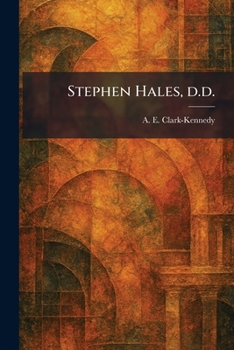
Stephen Hales, D.d.

"Stephen Hales, D.D." is an authoritative and scholarly biography of one of the eighteenth century's most influential and versatile scientific figures. Written by A. E. Clark-Kennedy, this work meticulously chronicles the life and achievements of Hales, a clergyman who became a pioneer in the fields of plant physiology and animal hemodynamics. The narrative delves into his landmark research, most notably his experiments detailed in "Vegetable Staticks," which laid the foundation for modern botany by applying quantitative physical methods to the study of plant life.
The book also explores Hales's groundbreaking work in animal physiology, where he was the first to accurately measure blood pressure, and his innovative contributions to public health through the invention of mechanical ventilators for ships, hospitals, and prisons. Beyond his scientific rigors, the work provides a portrait of Hales as the devoted perpetual curate of Teddington, illustrating the unique intersection of faith and empirical inquiry during the Enlightenment. This biography serves as a vital resource for understanding the historical development of the biological sciences and the legacy of a polymath whose empirical curiosity significantly advanced our knowledge of the living world.
This work has been selected by scholars as being culturally important, and is part of the knowledge base of civilization as we know it. This work was reproduced from the original artifact, and remains as true to the original work as possible. Therefore, you may see the original copyright references, library stamps (as most of these works have been housed in our most important libraries around the world), and other notations in the work.
This work is in the public domain in the United States of America, and possibly other nations. Within the United States, you may freely copy and distribute this work, as no entity (individual or corporate) has a copyright on the body of the work.
As a reproduction of a historical artifact, this work may contain missing or blurred pages, poor pictures, errant marks, etc. Scholars believe, and we concur, that this work is important enough to be preserved, reproduced, and made generally available to the public. We appreciate your support of the preservation process, and thank you for being an important part of keeping this knowledge alive and relevant.
Customer Reviews
ThriftBooks ® and the ThriftBooks ® logo are registered trademarks of Thrift Books Global, LLC
