


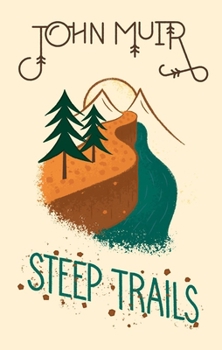
Steep Trails


Select Format
Select Condition 
Book Overview
A collection of essays exploring 29 years of beloved naturalist John Muir's life as he explored the West. Considered one of the patron saints of twentieth-century environmental activity, John Muir's appeal to modern readers is that he not only explored the American West but also fought for its preservation. Steep Trails collects together his essays and letters written as he traveled through the West, capturing the personal, heartfelt connection he had with the lands he roamed. His work takes the reader through the mountains and valleys of California, over the Cascades and the Wasatch Ranges, through Puget Sound and the forests of Washington and Oregon, and to the breathtaking Grand Canyon of Arizona. Muir's writing intimately connects the reader to the heart of nature; as the world increasingly tries to reconnect with the earth, Steep Trails offers the funny, charming, educational, and exalted wanderings of John Muir over nearly three decades of his life.
Format:Hardcover
Language:English
ISBN:1423653734
ISBN13:9781423653738
Release Date:March 2021
Publisher:Gibbs Smith
Length:224 Pages
Weight:0.76 lbs.
Dimensions:0.9" x 5.1" x 8.1"
Related Subjects
Conservationism Environmentalism Hiking Nature Writing History Literature & Fiction Nature TravelCustomer Reviews
1 rating
The original arch-druid
Published by Thriftbooks.com User , 24 years ago
Long before the late David Brower's environmental activism at the helm of the Sierra Club and after led to his designation as the `arch-druid,' John Muir was making epic journeys through the (then much more truly wild) wilderness of the U.S. western states and jotting down his observations as well as his thoughts on Nature and life in general. "Steep Trails" is a collection of pieces covering Muir's various travels through and about Northern California, Nevada, Utah, Oregon, Washington and the Grand Canyon. Writing mainly in the second half of the 19th century, Muir describes the terrain and its characteristics in simple and effective prose, but with the meticulous attention to detail and accuracy of a hard-nosed naturalist. One also cannot help but be impressed with the fact that Muir usually set off on his wilderness treks (often during the winter) with only the most meager of supplies and without the high-tech equipment and various Gore-Tex accoutrements deemed indispensible by today's rugged outdoorsmen. What comes out of Muir's writings and sets him apart from most of his contemporaries is his view that America's vast natural wealth and beauty should be appreciated in and of themselves, above and beyond their functional and economic value as natural resources to be exploited. Despite his firm belief in `progress' and `civilization' as these terms were understood in the nineteenth century (hence his often disparaging commments about the local Indians), at several points Muir showed that he understood the potential dangers of excessive economic development and industrialization.
Copyright © 2026 Thriftbooks.com Terms of Use
| Privacy Policy | Do Not
Sell/Share My Personal Information | Cookie Policy | Cookie Preferences | Accessibility Statement
ThriftBooks® and the ThriftBooks® logo are registered trademarks of Thrift Books Global, LLC
ThriftBooks® and the ThriftBooks® logo are registered trademarks of Thrift Books Global, LLC
