


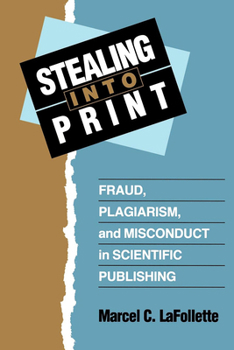
Stealing Into Print: Fraud, Plagiarism, and Misconduct in Scientific Publishing


Select Format
Select Condition 
Book Overview
False data published by a psychologist influence policies for treating the mentally retarded. A Nobel Prize-winning molecular biologist resigns the presidency of Rockefeller University in the wake of a scandal involving a co-author accused of fabricating data. A university investigating committee declares that almost half the published articles of a promising young radiologist are fraudulent.
Incidents like these strike at the heart of the scientific enterprise and shake the confidence of a society accustomed to thinking of scientists as selfless seekers of truth. Marcel LaFollette's long-awaited book gives a penetrating examination of the world of scientific publishing in which such incidents of misconduct take place. Because influential scientific journals have been involved in the controversies, LaFollette focuses on the fragile "peer review" process--the editorial system of seeking pre-publication opinions from experts. She addresses the cultural glorification of science, which, combined with a scientist's thirst for achievement, can seem to make cheating worth the danger. She describes the great risks taken by the accusers--often scholars of less prestige and power than the accused--whom she calls "nemesis figures" for their relentless dedication to uncovering dishonesty.
In sober warning, LaFollette notes that impatient calls from Congress, journalists, and taxpayers for greater accountability from scientists have important implications for the entire system of scientific research and communication.
Provocative and learned, Stealing Into Print is certain to become the authoritative work on scientific fraud, invaluable to the scientific community, policy makers, and the general public.
Incidents like these strike at the heart of the scientific enterprise and shake the confidence of a society accustomed to thinking of scientists as selfless seekers of truth. Marcel LaFollette's long-awaited book gives a penetrating examination of the world of scientific publishing in which such incidents of misconduct take place. Because influential scientific journals have been involved in the controversies, LaFollette focuses on the fragile "peer review" process--the editorial system of seeking pre-publication opinions from experts. She addresses the cultural glorification of science, which, combined with a scientist's thirst for achievement, can seem to make cheating worth the danger. She describes the great risks taken by the accusers--often scholars of less prestige and power than the accused--whom she calls "nemesis figures" for their relentless dedication to uncovering dishonesty.
In sober warning, LaFollette notes that impatient calls from Congress, journalists, and taxpayers for greater accountability from scientists have important implications for the entire system of scientific research and communication.
Provocative and learned, Stealing Into Print is certain to become the authoritative work on scientific fraud, invaluable to the scientific community, policy makers, and the general public.
Format:Paperback
Language:English
ISBN:0520205138
ISBN13:9780520205130
Release Date:March 1996
Publisher:University of California Press
Length:293 Pages
Weight:0.95 lbs.
Dimensions:0.8" x 6.0" x 9.0"
Customer Reviews
1 rating
A good start
Published by Thriftbooks.com User , 16 years ago
It is difficult to talk about scientific misconduct and fraud as much as it is to expose it when it is observed. Anyone doing so must be prepared to face an enormous amount of stress and the possibility of long-term unemployment if not total decimation of career. Even if these dire consequences do not result, one might still have to endure being labeled as a "troublemaker" or as having a "holier than thou" attitude. Being excluded from the profession that one has worked for with diligence will be painful of course, but on the other hand, looking the other way and being part of a corrupt and unethical system is always worse. The author of this book has outlined, mostly using anecdotal evidence, many of the unethical (if not illegal) practices that have tainted the scientific profession up to the time of publication. The reading of the book is very painful of course, but of great value mostly to those readers who are thinking about entering the scientific profession, and may be shocked at the some of the conduct that is regularly practiced among "scientists" and their administrators. Such readers may be expecting that they will be entering a community of rationalists, who sole purpose is the discovery of truth and who would never falsify data, plagiarize or steal other peoples ideas, or apply legal, institutional, or financial pressure to harm individuals who expose these practices. Being confronted with this kind of conduct for the uninitiated can be very disconcerting, and may even persuade some to exit the very profession where their talents and insights are sorely needed. The author doesn't really address in too much detail how to deal with the consequences of exposing fraud, but instead concentrates attention on some of the major cases that made the national press. In this regard his choices might be the worst part of the book, as there are many instances of fraud that do not have that notoriety but still need to be exposed. He also omits discussion of the some of the "lighter" forms of fraud that on the surface may not be viewed as such. For example, in a publication with multiple authorship, the practice of a particular author as being designated as "the author to whom correspondence must be addressed". This allows this author to take "control" of the publication henceforth and completely exclude further inputs or commentary from the other authors. In the experience of this reviewer it is the "senior" author, i.e. the head of the laboratory or research group, who demands this designation, and who makes the least contribution to the paper (if any). The author does discuss the practice of "shadow" authorship, where one or more authors have not made any contributions at all to the paper but nonetheless have their names on it. One can easily argue that more details should be included in the book, but as a whole the author has done a good job, and one can hope that this book and others will assist in preventing or exposing the sewers of fra
Copyright © 2026 Thriftbooks.com
Terms of Use | Privacy Policy | Do Not Sell/Share My Personal Information | Cookie Notice | Cookie Preferences | Accessibility Statement
ThriftBooks ® and the ThriftBooks ® logo are registered trademarks of Thrift Books Global, LLC
ThriftBooks ® and the ThriftBooks ® logo are registered trademarks of Thrift Books Global, LLC
