


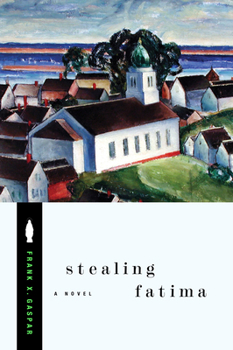
Stealing Fatima

Select Format
Select Condition 
Book Overview
As the last light of All-Hallows' Eve falls on a small town at the tip of Cape Cod, Father Manuel Furtado begins his nightly ritual of gin and pills, prayer, and hours spent writing feverishly in his ledger. With the deep luxury of the chemicals in his body, he copies passages from Saint Augustine and Martin Heidegger, disciplined in his desire to flesh out his ever-building demons. But, unlike his usual uninterrupted reflection, this night there is a crash, sudden enough to pull Father Manny from the rectory and toward his church, Our Lady of Fatima. He finds a man there - his childhood friend Sarafino, whom he has not seen in decades - frail with illness and desperate to tell the priest about his recurring visits from the Virgin Mary. Despite Father Manny's grave doubts about Sarafino and his visions, he lets his old friend into his home and his life, and this single act ignites a series of events that challenge the faith of this fishing village, the parish, and of Father Manny himself. Striking and lovingly detailed, Stealing Fatima is the story of a priest's search for redemption in a town where, even in these modern times, the divine is possible.
Format:Paperback
Language:English
ISBN:1582435162
ISBN13:9781582435169
Release Date:December 2009
Publisher:Counterpoint LLC
Length:400 Pages
Weight:0.90 lbs.
Dimensions:1.0" x 5.7" x 9.3"
Customer Reviews
4 ratings
Stealing Fatima by Frank Gaspar
Published by Thriftbooks.com User , 15 years ago
I've hoped for a "sequel" to Gaspar's novel, "Leaving Pico," (A book I've read twice over the years.)....so I was delighted to discover his latest novel! Reading Gaspar's new novel, "Stealing Fatima," I had the sense of returning to a familiar and welcome environment that was introduced in that first novel. Written in the same Provincetown, Cape Cod setting, but with different characters, Fatima reminds the reader of a familiar culture and spiritual place. These are people with depth who are revealed in moving and credible relationships with the protagonist, Father Manny Furtado. It is not surprising to learn that Gaspar is also a superb poet. Reading his novels recently led me to his poetry, specifically, Field Guide to the Heaven's. The poet's commitment to truth and authenticity, his attention to detail, is apparent throughout this novel. The priest's quest for understanding and faith is the crux of the book, and it is only fitting that his story be told in such rich language. After finishing the book, I found myself haunted by the character of Father Furtado as well as the pleasingly ambiguous ending of the story. Gaspar is an honest and thoughtful writer who creates a story (setting, characters, and plot: the whole package!) that draws you in and holds on to you, even after reading.
"The nature of everything is struggle"
Published by Thriftbooks.com User , 15 years ago
Frank X. Gaspar has written in Stealing Fatima a compelling story about Father Manny Furtado's personal struggle with faith, doubt, loss, and redemption. Everything is contained in this book, from blind faith to exquisite cynicism. It is Ahab relentlessly in search of Moby Dick, Huck Finn in pursuit of truth, the Compson family's discovery of strength and decadence. As Manny writes in his diary one night, "The nature of everything is struggle." Most remarkable about the book is the carved and wonderfully executed sentences, so many miniature works of art, like pieces of cathedral windows. All of the carefully drafted language and the fully developed characters require involved readers who are unafraid to face the consequences of the journey that they witnesses. Gaspar has captured the complex American spirit in this tale set Provincetown, Massachusetts.
A window into an engaging immigrant community.
Published by Thriftbooks.com User , 15 years ago
Frank X. Gaspar's Stealing Fatima is a meticulously crafted and engaging work of literary fiction. The setting, though unnamed, is obviously the Portuguese fishing village and arts colony of Provincetown on the tip of Cape Cod. The primary characters are Fr. Manuel Furtado and his long absent childhood friend, Sarafino Pomba. Sarafino returns dying of AIDs. He is convinced that he has experienced visitations from Our Lady of Fatima. It quickly becomes apparent that Sarafino brings other baggage; there is an outstanding arrest warrant for him for armed robbery. An additional matter that drives the narrative to its intriguing denouement is the fact that Fr. Furtado, "Manny" to his friends, is experiencing a profound inner conflict which can be descibed at least initiaslly as a disturbing crisis of faith or a hopeful trend toward rationality, depending on one's perspective: "He did not believe that Jesus was Divine or the Son of God, nor did he believe that God impregnated a young girl through the Holy Spirit (which now reminded him of Zeus and all his disguised copulations with humans). So he did not believe that Our Lady appeared to Sarafino Pomba or ever to anyone else. He did not believe in the Resurrection. He did not believe that God would sacrifice a son to be tortured to death in order to redeem a race of beings He himself created imprefectly." But more ominously, as he labors mightily to rebuild his previously neglected and dying parish by day, Father Furtado's life is further troubleed by an alarming degree self-medication for the pain of an old neck and shoulder injury. This is the result of a plane crash while serving in the military in Vietnam. His drugs of choice are Gordon's gin and polypharmacy; prescription pain pills obtained with a number of illicit prescriptions. He also has intermittent tinnitus, a ringing in the ears, which may be an early harbinger of hearing damage, a la Rush Limbaugh, from opiate abuse. The gin and pills have become the elements of his own and personal eucharist each evening as he sits alone in the rectory, scribbling away in his journal. Following the reappearance of Sarafino, in a well-constructed flash-back the reader learns that as adolescents, Manny and Sarafino, in an amphetamine induced spree, stole a treasured statue of our Lady of Fatima from the church where Manny now presides. Neither of them were found out. Both of the eighteen-year-olds entered military service and served in Vietnam shortly after the theft. The statue was never recovered. Our Lady of Fatima is beloved by many Catholics, in particular those of Portuguese extraction. Her story, eventually included in Manny's journal, references the six repeated apparitions of Virgin Mary as reported by three children. This is held as having occurred on the same day of a half dozen consecutive months beginning on May 13th, 1917 in Fátima, Portugal. The story has become iconic for many in the Portuguese community, in part because of its
A remarkable novel, engrossing and lyrical
Published by Thriftbooks.com User , 15 years ago
Stealing Fatima is a remarkable novel, as engrossing as it is profound. The writing is muscular and lyrical, the poet writing apparent on every page: "From inside the church wafted the muddled perfume of beeswax, flowers, traces of incense, the mellow lemon polish of oil and soap from the rubbed wooden pews. All a sweetness. . . . An amazing light in the honeyed gloom of the church, where the only radiance came from the little swarms of votive candles racked in the iron stands just inside the lateral doors. It was like a sky-glow or a gloaming" (p.16). Central to this work is Father Manuel (Manny) Furtado and his friend Sarafino and their conflicted spiritual journey toward redemption. This is one of the most spiritually engaging novels I have read in recent years.
Copyright © 2025 Thriftbooks.com
Terms of Use | Privacy Policy | Do Not Sell/Share My Personal Information | Cookie Policy | Cookie Preferences | Accessibility Statement
ThriftBooks ® and the ThriftBooks ® logo are registered trademarks of Thrift Books Global, LLC
ThriftBooks ® and the ThriftBooks ® logo are registered trademarks of Thrift Books Global, LLC
