


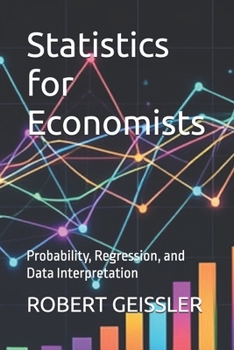
Statistics for Economists: Probability, Regression, and Data Interpretation

Every economic argument lives or dies on the data behind it.
Whether you're analyzing wage inequality, forecasting GDP, evaluating a policy intervention, or building an investment case, statistical fluency is the skill that separates rigorous analysis from informed guessing.
Statistics for Economists delivers a complete, application-driven guide to the quantitative methods that drive modern economic research. From probability theory and descriptive statistics to OLS regression, instrumental variables, and time series forecasting, each technique is explained clearly, connected to real economic questions, and grounded in the logic of evidence-based reasoning.
Inside you'll find:
Probability, distributions, and the Central Limit Theorem - explained the way economists actually use themEstimation theory, confidence intervals, and hypothesis testing - from first principles to applied practiceSimple and multiple regression, diagnostic methods, and robust standard errorsCausal inference tools: difference-in-differences, instrumental variables, and regression discontinuityLimited dependent variable models - logit, probit, Tobit, and ordered regressionTime series analysis: stationarity, ARIMA, cointegration, and error correctionApplied case studies including demand elasticity estimation, Mincer wage equations, and policy evaluationA comprehensive glossary of 70+ statistical and econometric termsThis is not a math textbook. It is a practitioner's guide - written for economics students, policy analysts, financial researchers, and anyone who needs to read, interpret, and produce empirical economic work with confidence.
Statistical thinking is not optional for economists. This book makes it accessible.
Customer Reviews
ThriftBooks ® and the ThriftBooks ® logo are registered trademarks of Thrift Books Global, LLC
