


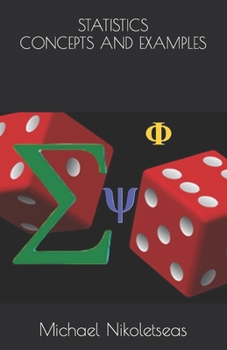
Statistics: Concepts and Examples
No Customer Reviews

Princeton University Libraries. Most students and professors in Philosophy and the Humanities in general, consider Statistics a boring mathematical tool of little or no relevance to their disciplines. Yet philosophers for thousands of years have been struggling with the concepts of Truth and Cause. The search for Truth has been in the core of philosophical discussions since the the time of the presocratic philosophers. Cause is a concept currently vividly discussed on web fora. Detailed Review of "Statistics: Concepts and Examples" by Michael M. Nikoletseas Introduction and Context
"Statistics: Concepts and Examples" by Michael M. Nikoletseas, first copyrighted in 2014 and revised in March 2024, is an introductory statistics textbook published in the USA, targeting college students and researchers, particularly those in philosophy and the humanities. The book, available on platforms like Amazon](https: //www.amazon.com/Statistics-Concepts-Examples-Michael-Nikoletseas/dp/1500815683) and referenced in university libraries such as Princeton University Library](https: //catalog.princeton.edu/catalog/10883135), aims to make statistical concepts accessible without requiring advanced mathematics beyond high school arithmetic. Teaching Methodology
Nikoletseas employs a unique and engaging teaching methodology, characterized by narratives and dramatic scenarios. For instance, the normal distribution is personified as a "goddess" with "magic qualities," explained through physical experiments like cutting and weighing a cardboard model (PAGE23, PAGE25, PAGE29). Other stories, such as "Mathematical Sweat" (PAGE38, PAGE39) and "Money in a Texas Hat" (PAGE262), embed statistical concepts in relatable contexts, such as analyzing exam scores or predicting heights for betting. This narrative style, combined with direct reader engagement ("you say," PAGE216), fosters an interactive and collaborative learning experience.
The book minimizes reliance on formulas, claiming that only five simple formulas are needed for all parametric statistics (PAGE242), covering topics from descriptive statistics (mean, mode, median, variance, standard deviation) to advanced methods like t-tests (PAGE209, PAGE210), ANOVA (PAGE200, PAGE215), and complex designs like mixed split-plot designs (PAGE219, PAGE223). It uses visual aids, such as graphs for interaction effects (PAGE196, PAGE201, PAGE202), and provides practical examples, like experiments involving drugs and electroshock (PAGE195, PAGE197, PAGE230), to illustrate statistical applications. Philosophical Integration
A distinctive feature is the integration of philosophical discussions on "Truth" and "Cause" in experimental science versus formal science (PAGE233, PAGE237, PAGE238). The book argues that findings in natural sciences are probabilistic and reliable, not absolute truths, urging readers to critically examine their tools and cognitive approaches before conducting research. This interdisciplinary perspective adds depth, connecting statistical methods to philosophical inquiries, which is particularly valuable for its target audience. Conclusion
"Statistics: Concepts and Examples" by Michael M. Nikoletseas is a refreshing and effective resource for learning statistics through a conceptual, story-driven lens. Its strengths lie in its accessibility, practical examples, and broad appeal, making it an excellent choice for students, researchers, and curious readers. It offers a novel and accessible entry point into statistics for non-mathematical audiences. Its emphasis on understanding over memorization, combined with engaging narratives and philosophical insights, makes it a worthwhile read for beginners. It seems likely to be particularly effective for its intended audience, providing a foundation for statistical literacy in the humanities.
"Statistics: Concepts and Examples" by Michael M. Nikoletseas, first copyrighted in 2014 and revised in March 2024, is an introductory statistics textbook published in the USA, targeting college students and researchers, particularly those in philosophy and the humanities. The book, available on platforms like Amazon](https: //www.amazon.com/Statistics-Concepts-Examples-Michael-Nikoletseas/dp/1500815683) and referenced in university libraries such as Princeton University Library](https: //catalog.princeton.edu/catalog/10883135), aims to make statistical concepts accessible without requiring advanced mathematics beyond high school arithmetic. Teaching Methodology
Nikoletseas employs a unique and engaging teaching methodology, characterized by narratives and dramatic scenarios. For instance, the normal distribution is personified as a "goddess" with "magic qualities," explained through physical experiments like cutting and weighing a cardboard model (PAGE23, PAGE25, PAGE29). Other stories, such as "Mathematical Sweat" (PAGE38, PAGE39) and "Money in a Texas Hat" (PAGE262), embed statistical concepts in relatable contexts, such as analyzing exam scores or predicting heights for betting. This narrative style, combined with direct reader engagement ("you say," PAGE216), fosters an interactive and collaborative learning experience.
The book minimizes reliance on formulas, claiming that only five simple formulas are needed for all parametric statistics (PAGE242), covering topics from descriptive statistics (mean, mode, median, variance, standard deviation) to advanced methods like t-tests (PAGE209, PAGE210), ANOVA (PAGE200, PAGE215), and complex designs like mixed split-plot designs (PAGE219, PAGE223). It uses visual aids, such as graphs for interaction effects (PAGE196, PAGE201, PAGE202), and provides practical examples, like experiments involving drugs and electroshock (PAGE195, PAGE197, PAGE230), to illustrate statistical applications. Philosophical Integration
A distinctive feature is the integration of philosophical discussions on "Truth" and "Cause" in experimental science versus formal science (PAGE233, PAGE237, PAGE238). The book argues that findings in natural sciences are probabilistic and reliable, not absolute truths, urging readers to critically examine their tools and cognitive approaches before conducting research. This interdisciplinary perspective adds depth, connecting statistical methods to philosophical inquiries, which is particularly valuable for its target audience. Conclusion
"Statistics: Concepts and Examples" by Michael M. Nikoletseas is a refreshing and effective resource for learning statistics through a conceptual, story-driven lens. Its strengths lie in its accessibility, practical examples, and broad appeal, making it an excellent choice for students, researchers, and curious readers. It offers a novel and accessible entry point into statistics for non-mathematical audiences. Its emphasis on understanding over memorization, combined with engaging narratives and philosophical insights, makes it a worthwhile read for beginners. It seems likely to be particularly effective for its intended audience, providing a foundation for statistical literacy in the humanities.
Format:Paperback
Language:English
ISBN:1500815683
ISBN13:9781500815684
Release Date:August 2014
Publisher:Createspace Independent Publishing Platform
Length:268 Pages
Weight:0.69 lbs.
Dimensions:0.6" x 5.5" x 8.5"
Customer Reviews
0 rating
Copyright © 2026 Thriftbooks.com Terms of Use
| Privacy Policy | Do Not
Sell/Share My Personal Information | Cookie Policy | Cookie Preferences | Accessibility Statement
ThriftBooks® and the ThriftBooks® logo are registered trademarks of Thrift Books Global, LLC
ThriftBooks® and the ThriftBooks® logo are registered trademarks of Thrift Books Global, LLC
