


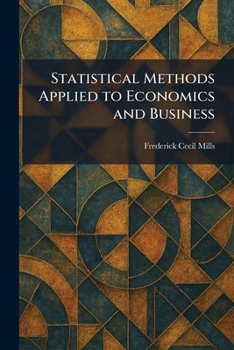
Statistical Methods Applied to Economics and Business

"Statistical Methods Applied to Economics and Business" is a foundational treatise on the quantitative tools used to analyze economic phenomena and business operations. Written by Frederick Cecil Mills, this comprehensive work bridges the gap between mathematical theory and practical application, providing a rigorous framework for understanding data in the social sciences. The text covers essential topics such as frequency distributions, averages, measures of dispersion, and the analysis of time series, all tailored to the specific needs of economists and business professionals.
The work emphasizes the importance of empirical evidence in decision-making and policy formulation. It introduces readers to the logic of statistical induction and the methods of correlation, offering clear explanations of how to interpret complex datasets. By focusing on the real-world utility of statistical measures, the book serves as both a pedagogical resource and a reference for those seeking to apply scientific rigor to financial and commercial inquiries.
With its systematic approach to indices, trends, and seasonal variations, "Statistical Methods Applied to Economics and Business" remains a significant contribution to the field of economic statistics. It illustrates the evolution of modern analytical techniques and continues to be valued for its clarity and depth in explaining how numerical data can illuminate the underlying structures of the market and the broader economy.
This work has been selected by scholars as being culturally important, and is part of the knowledge base of civilization as we know it. This work was reproduced from the original artifact, and remains as true to the original work as possible. Therefore, you may see the original copyright references, library stamps (as most of these works have been housed in our most important libraries around the world), and other notations in the work.
This work is in the public domain in the United States of America, and possibly other nations. Within the United States, you may freely copy and distribute this work, as no entity (individual or corporate) has a copyright on the body of the work.
As a reproduction of a historical artifact, this work may contain missing or blurred pages, poor pictures, errant marks, etc. Scholars believe, and we concur, that this work is important enough to be preserved, reproduced, and made generally available to the public. We appreciate your support of the preservation process, and thank you for being an important part of keeping this knowledge alive and relevant.
Customer Reviews
ThriftBooks ® and the ThriftBooks ® logo are registered trademarks of Thrift Books Global, LLC
