


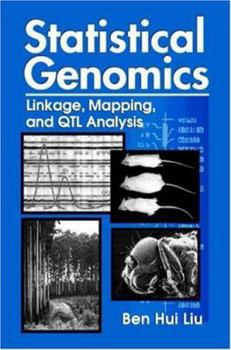
Statistical Genomics: Linkage, Mapping, and QTL Analysis

Select Format
Select Condition 
Book Overview
Genomics, the mapping of the entire genetic complement of an organism, is the new frontier in biology. This handbook on the statistical issues of genomics covers current methods and the tried-and-true... This description may be from another edition of this product.
Format:Hardcover
Language:English
ISBN:0849331668
ISBN13:9780849331664
Release Date:December 1997
Publisher:CRC Press
Length:642 Pages
Weight:2.95 lbs.
Dimensions:10.5" x 1.5" x 7.5"
Customer Reviews
3 ratings
Beautiful job
Published by Thriftbooks.com User , 23 years ago
The author of this book defines genomics as the study of whole genomes via the integration of cytology, Mendelian-quantitative-population-molecular genetics with bioinformatics and automated sequencing. It attempts to answer, the author states, such questions as to the physical and chemical requirements of genomes, the possible necessity that genes be located at certain sites to function normally, that particular DNA sequences and structures needed for gene functions, the total number of functional genes necessary for a biological system, and the homology between the DNA sequences of different species. He addresses the book to biologists interested in statistical issues in genomics, for mathematicians in genomics, and for students of genetics. To satisfy these three classes of readers, she lists three different "tracks" for them consisting of a sequence of chapters recommended. Another good feature of the book is the inclusion of exercises at the end of each chapter, an absolute necessity for the understanding of this field. For those interested specifically in the efficacy of transgenic strategies in the design of viable breeds of plants and animals, this book will be helpful, for the author emphasizes in the book that the major application of genomics will be in finding optimal breeding strategies in agriculture and forestry. After a brief introduction in chapter 1, the author outlines briefly Mendelian, population, quantitative, and molecular genetics in chapter 2, each presented as a separate discipline. The author never really defines what a gene "is" in the context of molecular genetics, as he does in the disciplines, but instead views it as a sequence of base pairs in the DNA strands, which has the potential of being expressed via transcription, RNA splicing, and translation, to a particular protein. Fortunately, in one of the exercises at the end of the chapter, the reader finds a connection between molecular and classical genetics by examining a trait (viewed as a simple compound) of a hypothetical plant. Genomics as a discipline is introduced in chapter 3, and defined as the analysis of data from nuclear genomes, with the intent of learning about their structure, function, and evolution. Genome structure and sources of genome variation are discussed. Biological techniques in genomics are briefly discussed for interested readers. The author is careful to point out that complex traits cannot be related to the DNA sequences available currently as little is known about the molecular identity of most genes controlling these traits. Helpful diagrams are used to illustrate the important concepts, such as mating schemes, chromosome rearrangements, "natural" populations used in genomic research, RAPD, AFLP, and a diagram outlining the history of genetic markers. Chapter 4 is a summary of the mathematical statistics needed in the book, but the author does give an example of the methods, dealing with mapping a gene for resistance to fusiform r
One of the best books in Molecular Quantitative Genetics
Published by Thriftbooks.com User , 25 years ago
The book discuses quantitative and population genetics on the bases of molecular level. It is very useful for genetic analysis across many disciplines, including plant and animal breeding, and human genetics. It provides useful explanations of some complex biometrical concepts.
A spetacular book
Published by Thriftbooks.com User , 25 years ago
That is one of the big book in this area. That book is spetacular and very simple to understand.
Copyright © 2026 Thriftbooks.com Terms of Use
| Privacy Policy | Do Not
Sell/Share My Personal Information | Cookie Policy | Cookie Preferences | Accessibility Statement
ThriftBooks® and the ThriftBooks® logo are registered trademarks of Thrift Books Global, LLC
ThriftBooks® and the ThriftBooks® logo are registered trademarks of Thrift Books Global, LLC
