


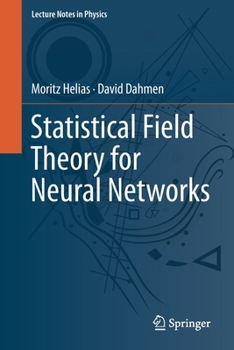
Statistical Field Theory for Neural Networks
No Customer Reviews

I. Introduction
II. Probabilities, moments, cumulantsA. Probabilities, observables, and momentsB. Transformation of random variablesC. CumulantsD. Connection between moments and cumulants
III. Gaussian distribution and Wick's theoremA. Gaussian distributionB. Moment and cumulant generating function of a GaussianC. Wick's theoremD. Graphical representation: Feynman diagramsE. Appendix: Self-adjoint operatorsF. Appendix: Normalization of a Gaussian
IV. Perturbation expansionA. General caseB. Special case of a Gaussian solvable theoryC. Example: Example: "phi 3 + phi 4" theoryD. External sourcesE. Cancellation of vacuum diagramsF. Equivalence of graphical rules for n-point correlation and n-th momentG. Example: "phi 3 + phi 4" theoryV. Linked cluster theoremA. General proof of the linked cluster theoremB. Dependence on j - external sources - two complimentary viewsC. Example: Connected diagrams of the "phi 3 + phi 4" theory
VI. Functional preliminariesA. Functional derivative1. Product rule2. Chain rule3. Special case of the chain rule: Fourier transformB. Functional Taylor series
VII. Functional formulation of stochastic differential equationsA. Onsager-Machlup path integral*B. Martin-Siggia-Rose-De Dominicis-Janssen (MSRDJ) path integralC. Moment generating functionalD. Response function in the MSRDJ formalism
VIII. Ornstein-Uhlenbeck process: The free Gaussian theoryA. DefinitionB. Propagators in time domainC. Propagators in Fourier domain
IX. Perturbation theory for stochastic differential equationsA. Vanishing moments of response fieldsB. Vanishing response loopsC. Feynman rules for SDEs in time domain and frequency domainD. Diagrams with more than a single external legE. Appendix: Unitary Fourier transform
X. Dynamic mean-field theory for random networksA. Definition of the model and generating functionalB. Property of self-averagingC. Average over the quenched disorderD. Stationary statistics: Self-consistent autocorrelation of as motion of a particle in a potentialE. Transition to chaosF. Assessing chaos by a pair of identical systemsG. Schr?dinger equation for the maximum Lyapunov exponentH. Condition for transition to chaos
XI. Vertex generating functionA. Motivating example for the expansion around a non-vanishing mean valueB. Legendre transform and definition of the vertex generating function GammaC. Perturbation expansion of GammaD. Generalized one-line irreducibilityE. ExampleF. Vertex functions in the Gaussian caseG. Example: Vertex functions of the "phi 3 + phi 4"-theoryH. Appendix: Explicit cancellation until second orderI. Appendix: Convexity of WJ. Appendix: Legendre transform of a Gaussian
XII. Application: TAP approximationInverse problem
XIII. Expansion of cumulants into tree diagrams of vertex functionsA. Self-energy or mass operator Sigma
XIV. Loopwise expansion of the effective action - Tree levelA. Counting the number of loopsB. Loopwise expansion of the effective action - Higher numbers of loopsC. Example: phi 3 + phi 4-theoryD. Appendix: Equivalence of loopwise expansion and
II. Probabilities, moments, cumulantsA. Probabilities, observables, and momentsB. Transformation of random variablesC. CumulantsD. Connection between moments and cumulants
III. Gaussian distribution and Wick's theoremA. Gaussian distributionB. Moment and cumulant generating function of a GaussianC. Wick's theoremD. Graphical representation: Feynman diagramsE. Appendix: Self-adjoint operatorsF. Appendix: Normalization of a Gaussian
IV. Perturbation expansionA. General caseB. Special case of a Gaussian solvable theoryC. Example: Example: "phi 3 + phi 4" theoryD. External sourcesE. Cancellation of vacuum diagramsF. Equivalence of graphical rules for n-point correlation and n-th momentG. Example: "phi 3 + phi 4" theoryV. Linked cluster theoremA. General proof of the linked cluster theoremB. Dependence on j - external sources - two complimentary viewsC. Example: Connected diagrams of the "phi 3 + phi 4" theory
VI. Functional preliminariesA. Functional derivative1. Product rule2. Chain rule3. Special case of the chain rule: Fourier transformB. Functional Taylor series
VII. Functional formulation of stochastic differential equationsA. Onsager-Machlup path integral*B. Martin-Siggia-Rose-De Dominicis-Janssen (MSRDJ) path integralC. Moment generating functionalD. Response function in the MSRDJ formalism
VIII. Ornstein-Uhlenbeck process: The free Gaussian theoryA. DefinitionB. Propagators in time domainC. Propagators in Fourier domain
IX. Perturbation theory for stochastic differential equationsA. Vanishing moments of response fieldsB. Vanishing response loopsC. Feynman rules for SDEs in time domain and frequency domainD. Diagrams with more than a single external legE. Appendix: Unitary Fourier transform
X. Dynamic mean-field theory for random networksA. Definition of the model and generating functionalB. Property of self-averagingC. Average over the quenched disorderD. Stationary statistics: Self-consistent autocorrelation of as motion of a particle in a potentialE. Transition to chaosF. Assessing chaos by a pair of identical systemsG. Schr?dinger equation for the maximum Lyapunov exponentH. Condition for transition to chaos
XI. Vertex generating functionA. Motivating example for the expansion around a non-vanishing mean valueB. Legendre transform and definition of the vertex generating function GammaC. Perturbation expansion of GammaD. Generalized one-line irreducibilityE. ExampleF. Vertex functions in the Gaussian caseG. Example: Vertex functions of the "phi 3 + phi 4"-theoryH. Appendix: Explicit cancellation until second orderI. Appendix: Convexity of WJ. Appendix: Legendre transform of a Gaussian
XII. Application: TAP approximationInverse problem
XIII. Expansion of cumulants into tree diagrams of vertex functionsA. Self-energy or mass operator Sigma
XIV. Loopwise expansion of the effective action - Tree levelA. Counting the number of loopsB. Loopwise expansion of the effective action - Higher numbers of loopsC. Example: phi 3 + phi 4-theoryD. Appendix: Equivalence of loopwise expansion and
Format:Paperback
Language:English
ISBN:3030464431
ISBN13:9783030464431
Release Date:August 2020
Publisher:Springer
Length:203 Pages
Weight:0.92 lbs.
Dimensions:0.5" x 6.1" x 9.2"
Customer Reviews
0 rating
Copyright © 2026 Thriftbooks.com Terms of Use
| Privacy Policy | Do Not
Sell/Share My Personal Information | Cookie Policy | Cookie Preferences | Accessibility Statement
ThriftBooks® and the ThriftBooks® logo are registered trademarks of Thrift Books Global, LLC
ThriftBooks® and the ThriftBooks® logo are registered trademarks of Thrift Books Global, LLC
