


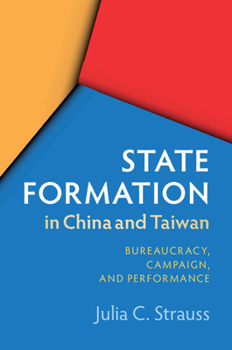
State Formation in China and Taiwan: Bureaucracy, Campaign, and Performance
No Customer Reviews

This is an ambitious comparative study of regime consolidation in the 'revolutionary' People's Republic of China and the 'conservative' Republic of China (Taiwan) in the years following the communist victory against the nationalists on the Chinese mainland in 1949. Julia C. Strauss argues that accounting for these two variants of the Chinese state solely in terms of their divergent ideology and institutions fails to recognise their similarities and their relative successes. Both, after all, emerged from a common background of Leninist party organization amid civil war and foreign invasion. However, by the mid-1950s they were on clearly different trajectories of state-building and development. Focusing on Sunan and Taiwan, Strauss considers state personnel, the use of terror and land reform to explore the evolution of these revolutionary and conservative regimes between 1949 and 1954. In so doing, she sheds important new light on twentieth-century political change in East Asia, deepening our understanding of state formation.
Format:Paperback
Language:English
ISBN:1108701655
ISBN13:9781108701655
Release Date:November 2019
Publisher:Cambridge University Press
Length:292 Pages
Weight:1.40 lbs.
Dimensions:0.9" x 6.6" x 9.4"
Customer Reviews
0 rating
Copyright © 2026 Thriftbooks.com Terms of Use
| Privacy Policy | Do Not
Sell/Share My Personal Information | Cookie Policy | Cookie Preferences | Accessibility Statement
ThriftBooks® and the ThriftBooks® logo are registered trademarks of Thrift Books Global, LLC
ThriftBooks® and the ThriftBooks® logo are registered trademarks of Thrift Books Global, LLC
