


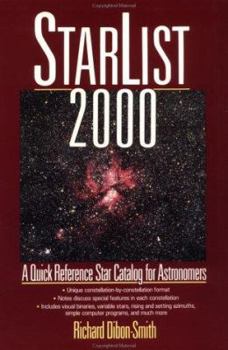
StarList 2000: A Quick Reference Star Catalog for Astronomers

Select Format
Select Condition 
Book Overview
Which is larger, Sirius or Vega? What is the luminosity of Rigel? When will Mira come up to full brightness? Here's one simple-to-use reference which quickly answers these questions and many more. This handy star catalog gives the characteristics of over 2,000 stars to a brightness of 5.25 visual magnitude (plus many dimmer exceptions) updated with Epoch 2000 data. The book brings together information not available in any other single source. Employing a unique, easy-to-use constellation-by-constellation format, StarList 2000 gives you all these properties for each star: location, visual and absolute magnitude, spectra, distance in light years, proper motion, spatial and radial velocity, parallax, size, and luminosity. Notes compare discrepancies in data from well-known sources and point out additional interesting facts and figures about selected stars and deep sky objects, such as nearby nebulae. There are special sections on binaries and variables. Rapid-motion binaries are covered in detail, giving exact locations at January 1, 2000. There is also a collection of drawn orbits and a listing of orbital elements of selected binaries. Data on variable stars include type of variability, maximum and minimum visual magnitude, epoch, and period of variability. The author also offers a unique feature--"Most Favorable Viewing Date"--that tells readers when variables are expected to be at their brightest. StarList 2000 includes an appendix of computer programs for calculating such information as the Julian Date, the date of midnight transit for any star, and the azimuth and altitude of any star viewed from your own backyard. Indexes list stars by right ascension, popular name, and constellation.
Format:Paperback
Language:English
ISBN:0471558958
ISBN13:9780471558958
Release Date:July 1992
Publisher:John Wiley &Sons
Length:416 Pages
Weight:1.70 lbs.
Dimensions:10.0" x 0.9" x 7.0"
Customer Reviews
1 rating
Excellent for Astronomy buffs and Science Fiction buffs
Published by Thriftbooks.com User , 25 years ago
This book has three parts: the Starlist, the visual binary stars (includes drawn orbits), and the variable stars (includes graphs of maxima/minima). Excellent ephemerides.The first part, the Starlist, has been an indispensable source of information. Stars are listed by constellation and includes: RA/Dec, spectral classification, absolute magnitude, apparent magnitude, distance (in light years), parallax, proper motion, direction of apparent motion (disregarding precession), space velocity, radial velocity (where known), size (in solar diameters), luminosity, and Henry Draper Catalogue star reference number (HD). There are many remarks/comments throughout, on various stars. These remarks are concise and helpful, and show Mr. Dibon-Smith's love for the field. Think of it as a one volume condensed Burnham's Celestial Handbook.The second section of this book, visual binaries, includes the combined magnitude, apparent magnitude of each component (with a few exceptions, only the brightest pair of a multiple system), PA/Sep, and orbital information. At the end of the section is a graphic representation of the orbits of binaries with periods of 300 years or less. The third section, variable stars. They are listed by subgroup: pulsating, eruptive, rotating, peculiar, eclipsing, and type uncertain. The first part has graphs of the maxima/minima of Mira type stars, and some semiregular variable stars. Part three also lists type of variable, maximum range, epoch, period, and best viewing dates.That's not all this book offers. There is a section on computer programs (in BASIC) to find: day of the week (given the Julian date), Julian date (given the calendar date), calendar date/day of the week (given the Julian date), position of a star (given the RA/Dec and latitude/longitude of the observer), RA on the meridian (given the calendar date), midnight transit of a star (given the RA), and the approximate date of maxima of a long-period variable. Another section lists stars by RA. Another section identifies star names (fun if you had no idea where Zubenalgubi is...it's Sigma Librae). The bibliography and indices are also helpful.I learned that this book is also tons-o-fun for the science fiction buff, too. So, the space ninja chased the nasty asteroid pirates all the way to Phi Eridani, did they? Well, now you'll know that Phi Eridani is a B8 V, and 180 light years away.Seriously, this book has been indispensable. It's fun to browse though for kicks, and it's extremely helpful if you're into Astronomy.
Copyright © 2026 Thriftbooks.com Terms of Use
| Privacy Policy | Do Not
Sell/Share My Personal Information | Cookie Policy | Cookie Preferences | Accessibility Statement
ThriftBooks® and the ThriftBooks® logo are registered trademarks of Thrift Books Global, LLC
ThriftBooks® and the ThriftBooks® logo are registered trademarks of Thrift Books Global, LLC
