


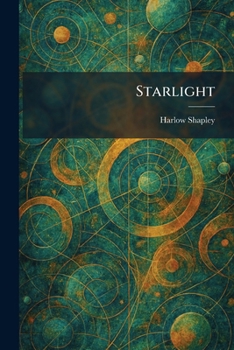
Starlight

Select Format
Select Condition 
Book Overview
"Starlight" is an illuminating exploration of the cosmos written by the distinguished astronomer Harlow Shapley. This work serves as an accessible gateway into the vast complexities of the universe, focusing on the nature, composition, and evolution of the stars that populate our night sky. Shapley, a pioneer in identifying the scale of the Milky Way, brings his profound expertise to the general reader, explaining how light from distant suns reveals the fundamental laws of physics and the grand structure of space.
The book delves into the classification of stars, the mysteries of nebulae, and the then-emerging understanding of the galaxy's dimensions. By bridging the gap between rigorous scientific observation and public curiosity, "Starlight" provides a foundational look at the tools of the astronomer and the celestial bodies they study. It captures a pivotal moment in the history of science when our understanding of the universe's size and the sun's position within it was undergoing a radical transformation. Readers interested in the history of astronomy and the timeless beauty of the heavens will find this work both informative and inspiring, as it chronicles the human endeavor to map the infinite reaches of the stellar world.
This work has been selected by scholars as being culturally important, and is part of the knowledge base of civilization as we know it. This work was reproduced from the original artifact, and remains as true to the original work as possible. Therefore, you may see the original copyright references, library stamps (as most of these works have been housed in our most important libraries around the world), and other notations in the work.
This work is in the public domain in the United States of America, and possibly other nations. Within the United States, you may freely copy and distribute this work, as no entity (individual or corporate) has a copyright on the body of the work.
As a reproduction of a historical artifact, this work may contain missing or blurred pages, poor pictures, errant marks, etc. Scholars believe, and we concur, that this work is important enough to be preserved, reproduced, and made generally available to the public. We appreciate your support of the preservation process, and thank you for being an important part of keeping this knowledge alive and relevant.
Customer Reviews
ThriftBooks ® and the ThriftBooks ® logo are registered trademarks of Thrift Books Global, LLC
