


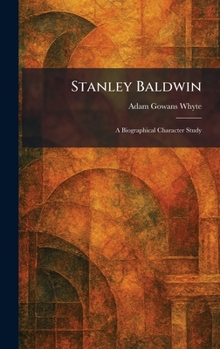
Stanley Baldwin: A Biographical Character Study

"Stanley Baldwin: A Biographical Character Study" provides an insightful look into the life and political career of one of Great Britain's most influential early 20th-century leaders. Written by Adam Gowans Whyte, this work goes beyond a mere chronological account of events to offer a deep exploration of the personality and principles that defined Baldwin's leadership during a transformative era in British history.
The study examines Baldwin's rise within the Conservative Party, his approach to the complex social and economic challenges of the post-war period, and the unique temperament that allowed him to connect with the public. Whyte delves into the character of a man who navigated significant events like the General Strike and sought to maintain national stability amidst shifting global dynamics. As a contemporary evaluation, this volume captures the political atmosphere of the 1920s with unique immediacy.
This work remains an essential resource for those interested in the development of modern conservatism and the psychological dimensions of political power. By focusing on the intersection of personal character and public duty, "Stanley Baldwin: A Biographical Character Study" highlights the enduring legacy of a statesman whose steady hand shaped the course of the British Empire between the World Wars.
This work has been selected by scholars as being culturally important, and is part of the knowledge base of civilization as we know it. This work was reproduced from the original artifact, and remains as true to the original work as possible. Therefore, you may see the original copyright references, library stamps (as most of these works have been housed in our most important libraries around the world), and other notations in the work.
This work is in the public domain in the United States of America, and possibly other nations. Within the United States, you may freely copy and distribute this work, as no entity (individual or corporate) has a copyright on the body of the work.
As a reproduction of a historical artifact, this work may contain missing or blurred pages, poor pictures, errant marks, etc. Scholars believe, and we concur, that this work is important enough to be preserved, reproduced, and made generally available to the public. We appreciate your support of the preservation process, and thank you for being an important part of keeping this knowledge alive and relevant.
Customer Reviews
ThriftBooks ® and the ThriftBooks ® logo are registered trademarks of Thrift Books Global, LLC
