


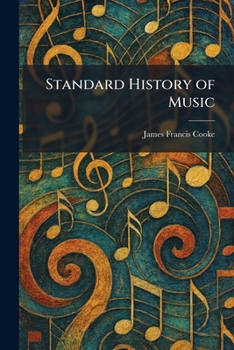
Standard History of Music

Select Format
Select Condition 
Book Overview
"Standard History of Music" is a comprehensive and accessible guide designed to introduce readers to the vast landscape of musical development through the ages. Written by James Francis Cooke, this work serves as an essential resource for students, teachers, and music lovers who seek a clear understanding of how music evolved from ancient traditions to the early 20th century.
The book provides a chronological overview of significant periods, including the Renaissance, Baroque, Classical, and Romantic eras. It highlights the lives and contributions of major composers, such as Bach, Mozart, Beethoven, and Wagner, while also exploring the development of musical instruments and various forms of composition. Cooke's approach combines biographical sketches with historical context, making the complexities of music history approachable for a general audience.
Organized into concise chapters, "Standard History of Music" is structured to facilitate learning and retention, featuring a pedagogical style that has made it a staple in music appreciation for generations. This work remains a valuable historical document in the field of music pedagogy, offering insights into how musical history was taught and appreciated during the early decades of the 20th century. Its enduring value lies in its ability to synthesize a vast amount of information into a narrative that celebrates the enduring power of musical expression.
This work has been selected by scholars as being culturally important, and is part of the knowledge base of civilization as we know it. This work was reproduced from the original artifact, and remains as true to the original work as possible. Therefore, you may see the original copyright references, library stamps (as most of these works have been housed in our most important libraries around the world), and other notations in the work.
This work is in the public domain in the United States of America, and possibly other nations. Within the United States, you may freely copy and distribute this work, as no entity (individual or corporate) has a copyright on the body of the work.
As a reproduction of a historical artifact, this work may contain missing or blurred pages, poor pictures, errant marks, etc. Scholars believe, and we concur, that this work is important enough to be preserved, reproduced, and made generally available to the public. We appreciate your support of the preservation process, and thank you for being an important part of keeping this knowledge alive and relevant.
Customer Reviews
ThriftBooks ® and the ThriftBooks ® logo are registered trademarks of Thrift Books Global, LLC
