


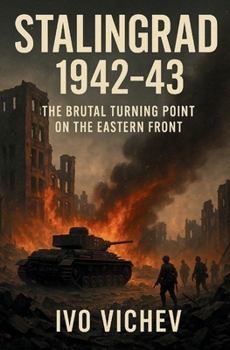
Stalingrad 1942-43: The Brutal Turning Point on the Eastern Front

"In the winter of 1942, the fate of Europe burned on the banks of the Volga."
When Adolf Hitler unleashed Operation Blue, he believed victory in the East was inevitable. His armies surged toward the Caucasus oil fields and the city that bore his enemy's name-Stalingrad. What followed was a cataclysm that devoured entire armies, reshaped nations, and marked the brutal turning point of World War II.
In Stalingrad 1942-43: The Brutal Turning Point on the Eastern Front, historian Ivo Vichev delivers a cinematic, unflinching chronicle of the battle that defined modern warfare. Through gripping narrative and meticulous research, Vichev reconstructs the clash between the German 6th Army and the Red Army across the smoking ruins of a city reduced to rubble. The result is both a military history of unparalleled precision and a haunting portrait of humanity at its breaking point.
Readers are taken from Hitler's Directive 41-the fateful decision that split his forces and doomed his campaign-to the final collapse inside the Stalingrad pocket. You will march beside German panzer crews through the dust of the steppe, fight alongside Soviet factory workers defending the Red October steel plant, and endure the freezing nights on the Volga where starvation, disease, and desperation reigned. Every chapter reveals not just strategy and movement, but the lives behind them-the soldiers, civilians, and commanders caught in the maelstrom of history's bloodiest urban battle.
Vichev's storytelling combines the precision of a historian with the immediacy of a war correspondent. Drawing from archival documents, wartime diaries, Soviet and German reports, and eyewitness testimonies, he brings to life both sides of the front: the fanatic determination of Hitler's Wehrmacht and the indomitable resilience of Stalin's Red Army. Each page exposes the psychological collapse of German command, the moral endurance of Soviet defenders, and the sheer scale of human suffering that transformed a city into a symbol of total war.
Through eight detailed chapters-including The Road to Stalingrad, Fire from the Sky, Into the Inferno, Rattenkrieg, and The Industrial Fortresses-the book explores every dimension of the siege:
Strategy and command - the fatal flaws of Hitler's divided objectives and Paulus's cautious leadership.
Urban warfare - the emergence of "Rattenkrieg," the war of the rats, where combat raged from basement to rooftop.
Civilians and survival - the tragedy of an entire population trapped between annihilation and resistance.
The Volga lifeline - the desperate supply crossings that sustained the Soviet defense against impossible odds.
The encirclement and collapse - Operation Uranus and the moment the hunter became the hunted.
By the time the guns fell silent in February 1943, over two million soldiers and civilians had perished. The German 6th Army ceased to exist. Hitler's dream of Eastern conquest died with it, and the Soviet Union began its relentless advance toward Berlin. Stalingrad became more than a battle-it became a symbol of endurance, sacrifice, and the high cost of hubris.
Stalingrad 1942-43 is more than a history book. It is an immersive journey into the psychology of men under fire, the machinery of total war, and the moment when the tide of the twentieth century turned.
Perfect for readers of Antony Beevor, Max Hastings, Rick Atkinson, and John Keegan, this work belongs on the shelf of anyone who seeks to understand the true scale and horror of the Eastern Front.
Related Subjects
HistoryCustomer Reviews
ThriftBooks ® and the ThriftBooks ® logo are registered trademarks of Thrift Books Global, LLC
