


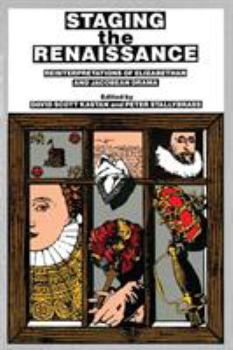
Staging the Renaissance

Select Format
Select Condition 
Book Overview
The essays in Staging the Renaissance show the theatre to be the site of a rich confluence of cultural forces, the place where social meanings are both formed and transformed. The volume unites some of the most challenging issues in contemporary Renaissance studies and some of our best-known critics, including Stephen Orgel, Margaret Ferguson, Catherine Belsey, Jonathan Goldberg, Marjorie Garber, Lisa Jardine, and Jonathan Dollimore-- demonstrating the variety and vitality not only of contemporary criticism, but of Renaissance drama itself.
Format:Paperback
Language:English
ISBN:0415901669
ISBN13:9780415901666
Release Date:December 1991
Publisher:Routledge
Length:304 Pages
Weight:0.90 lbs.
Dimensions:0.6" x 6.1" x 9.2"
Grade Range:Postsecondary and higher
Customer Reviews
1 rating
Bodies of Power!
Published by Thriftbooks.com User , 21 years ago
Staging the Renaissance: Reinterpretations of Elizabethan and Jacobean Drama was the readable series of essays, edited by noted Renaissance theatre historians David Kastan and Peter Stallybrass, that turned me on to the rebellious energy of the Elizabethan stage. All essays have a focus on "bodies" as sites of power and demarcation. My personal favorite essays: Chapter 2- Steven Mullaney's "Civic Rites, City Sites: The Place of the Stage." Here, Mullaney situates the borders/margins/transitional zones of London as being of symbolic importance in the 16th century because they contained all that could be considered liminal (by nature of being both censured and licensed). The margins were where the lepers, whores, drunkards, mountebanks, molly-house attenders and actors had their respective "theatres," all components of "liminal space," all socially, culturally and geographically empowered sites by nature of their marginality. The city embodies memory as the actor embodies a role. Chapter 3- Leonard Tennehouse's "Playing and Power." In essence, the section speaks of Queen Elizabeth's very body as being a site which "contained and stood for [her] power"(27). My thought? Michel Foucault asserted in his History of Sexuality (Volume 1) that, to paraphrase, Queen Victoria was "every Victorian" because she was the Authority/Breast, and simultaneously was Jack the Ripper! Chapter 8, Jonathan Goldberg's "Sodomy and Society: The Case of Christopher Marlowe." The charges of Marlowe was as a "heretic and somdomite (sic-81)." speculation that the author of Edward II might have had a sexual relationship with roommate Thomas Kyd or others. Of course, it did not matter. Epigrams such as "all they that love not Tobacco and Boies are fooles" speak of an outrageous sensibility which paraded the threat of bodily pleasure, both sanctioned and taboo (smoking, diddling boys) as a source of power. It is the incipient desire in his turns of phrase which drives the fall of Edward in Edward II. It makes no difference if Christopher Marlowe was an occasional lover of men, it is participation in the discourse of sodomy which characterized this "bad boy," in his own time, in his rude death, and in his historical memory. The site of power which Marlowe wielded/s may be, according to Goldberg, the same Otherness with which society "empowers" contemporary "sodomites." Historical, material, geotopical bodies. . . .receptacles for memory? Or powerful sites? It's all interesting stuff and, ultimately, very contemporary. Read this book to reaffirm how little things change, either in the theatres or on the world stage of political posturing.
Copyright © 2026 Thriftbooks.com
Terms of Use | Privacy Policy | Do Not Sell/Share My Personal Information | Cookie Policy | Cookie Preferences | Accessibility Statement
ThriftBooks ® and the ThriftBooks ® logo are registered trademarks of Thrift Books Global, LLC
ThriftBooks ® and the ThriftBooks ® logo are registered trademarks of Thrift Books Global, LLC
