


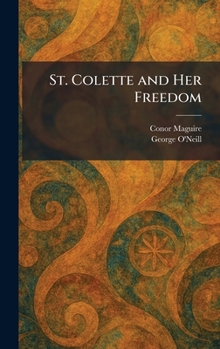
St. Colette and Her Freedom

"St. Colette and Her Freedom" is an evocative biographical study of Saint Colette of Corbie, the visionary 15th-century reformer who revitalized the Franciscan Order of the Poor Clares. The work chronicles her spiritual journey, from her early life of solitude and prayer to her emergence as a powerful leader capable of enacting significant ecclesiastical reform. It captures the essence of her devotion to the original ideals of Saint Francis and Saint Clare, detailing her efforts to restore strict poverty and discipline within the monastic life.
The narrative explores the historical and religious context of Colette's mission, illustrating the challenges she faced while establishing and reformulating dozens of convents across Europe. Key themes include her mystical experiences, her unwavering commitment to the ascetic life, and the profound impact she had on the religious landscape of her time. This account offers readers a deep look into the character and legacy of a saint who balanced intense contemplation with a pragmatic approach to institutional renewal. "St. Colette and Her Freedom" remains an essential text for those interested in medieval hagiography, the history of the Catholic Church, and the enduring influence of female figures in religious history.
This work has been selected by scholars as being culturally important, and is part of the knowledge base of civilization as we know it. This work was reproduced from the original artifact, and remains as true to the original work as possible. Therefore, you may see the original copyright references, library stamps (as most of these works have been housed in our most important libraries around the world), and other notations in the work.
This work is in the public domain in the United States of America, and possibly other nations. Within the United States, you may freely copy and distribute this work, as no entity (individual or corporate) has a copyright on the body of the work.
As a reproduction of a historical artifact, this work may contain missing or blurred pages, poor pictures, errant marks, etc. Scholars believe, and we concur, that this work is important enough to be preserved, reproduced, and made generally available to the public. We appreciate your support of the preservation process, and thank you for being an important part of keeping this knowledge alive and relevant.
Customer Reviews
ThriftBooks ® and the ThriftBooks ® logo are registered trademarks of Thrift Books Global, LLC
