


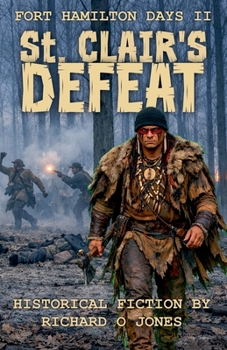
St. Clair's Defeat

In the autumn of 1791, the United States Army marched north from Fort Washington into the Ohio woods to settle the Indian question once and for all. They never finished the march. They never settled anything. What was left of them came stumbling back twenty-nine miles through cast-off muskets and frozen blood and bodies the army would not return to bury for two and a half years.
This is the story of that march, the morning that ended it, and the long winter after.
On November 4, near the headwaters of the Wabash, the army of General Arthur St. Clair was met at dawn by a confederacy of warriors under Little Turtle and Blue Jacket. Inside three hours, six hundred and thirty Americans were dead. Two hundred and seventy more were wounded. Cannon were left in the mud. The old general was carried out on a litter, weeping. It remains the worst defeat the United States Army has ever suffered at the hands of an indigenous force, and you have probably never heard of it.
Word was the campaign had been ill-starred from the start. The contractors couldn't keep the column fed. The militia drank what they could carry and deserted in lots of sixty. The general was sick - gout, rheumatism, dysentery, take your pick - and rode out that morning leaning on two officers, his hair undone, his coat unbuttoned, a man already half a casualty before the first shot was fired. By breakfast he had lost his army.
Across nine voices and fifty chapters, this book follows the long unraveling.
Major David Ziegler, German-born, a Turkish saber scar across his scalp, holds the rear guard intact down the bloody Trace and is sent back north with a hundred men to relieve the cut-off garrison at Fort Jefferson, where the survivors are eating horse flesh and green hides.
Captain Erkuries Beatty stands at the gate of Fort Hamilton on the night of November 8 and counts the broken column back into the stockade, and goes on counting through the long winter, because somebody has to.
Hannah Cobb walks the Trace alone in November and walks it back with a knife scar across her face and a story she will not tell. When the survivors come south, a man she does not know hands her her husband's pocket watch, and she does not open it.
A Kentucky horse-master named Tackett counts ninety animals out of Fort Hamilton and counts them down toward nothing.
A militia scout the men call Dream Talker counts down the days to a battle he should not be able to see.
A schoolmaster named Reily walks back up the Trace in the dead of winter to write down what was left there - men frozen in postures of running, an unfinished letter in a frozen hand, a pewter button no widow will ever claim.
A free Black teamster named Solomon Ayers, who answers to Ben Crow, carries a general's litter off the field and carries the secret of his own freedom out with it.
And a Shawnee woman long dead - Nonhelema, the Grenadier - walks beside the Butler brothers in the kind of ghost story the Ohio country specializes in.
Through all of it runs the Trace, the rough cut hacked through the timber by Josiah Harmar's men the year before, widened by St. Clair's column on the way north and walked back over by ghosts on the way south. The Trace is a character in this book. So is the weather. So is the silence that fell between Fort Hamilton and Fort Washington when the express riders couldn't get the mail through.
The second volume of the Fort Hamilton chronicles. A book about a forgotten disaster, told from inside the disaster by the men and women who were there. Meant to be read with snow blowing against the window and the fire burning low.
Customer Reviews
ThriftBooks ® and the ThriftBooks ® logo are registered trademarks of Thrift Books Global, LLC
