


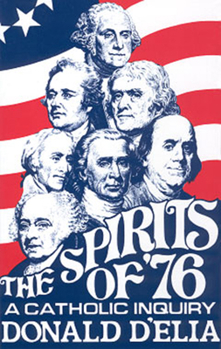
Spirits of '76: Catholic Inquiry


Historian Donald D'Elia offers one of the most original sets of essays ever penned on the seven greatest founding fathers looking at the development of their philosophical and religious convictions. The essays include: The Relevance of Thomas Jefferson, Benjamin Rush: A Christian Revolutionary, John Adams: Revolutionary as Manichaean, Charles Carroll of Carrollton: A Catholic Revolutionary, George Washington: The Founder as Stoic, Alexander Hamilton: From Caesar to Christ, and Benjamin Franklin: Poor Richard's Religion.
Format:Paperback
Language:English
ISBN:0931888107
ISBN13:9780931888106
Release Date:October 2004
Publisher:Christendom Press
Length:182 Pages
Weight:0.55 lbs.
Related Subjects
HistoryCustomer Reviews
1 rating
The Peril of Modernizing the Founders
Published by Thriftbooks.com User , 20 years ago
The founding fathers are an interesting collection of men. Unfortunately, rather than let them speak for themselves, there is a tendency to recreate them in our own image. Many conservative Protestants (particularly those associated with the Religious Right) often make them out to be fellow orthodox believers, some going to far as to claim that every reference by the founders to "God" and "religion" means the Christian religion and the Christian god. On the other hand, many on the left assert that they were followers of the Enlightenment and mostly Deists. Curiously, Roman Catholics have occasionally suspected that the founders may have drunk too much from Enlightenment and Masonic streams. Catholic historian Donald D'Elia provides brief studies on the religious beliefs of seven founders: Thomas Jefferson, Benjamin Rush, John Adams, Charles Carroll of Carrollton, George Washington, Alexander Hamilton and Benjamin Franklin. Prof. D'Elia's studies are interesting. Benjamin Rush was a Protestant who viewed Christianity as essential to the American Revolution. Charles Carroll of Carrollton (a signer of the Declaration) was a devout Catholic. John Adams rejected his New England Calvinism in favor of Unitarianism. Thomas Jefferson was an opponent of traditional religion if there ever was one. George Washington was an Episcopalian whose religious beliefs likely weren't all that traditional, but probably shouldn't be considered a Deist (although he may have been close to one). Benjamin Franklin belonged to the Enlightenment but had a certain pragmatic respect for religion. Alexander's Hamilton's Christianity appears to have been off and on. In his final moments he called for the Episcopal bishop to receive communion. If Prof. D'Elia's sample is representative of the founders, they appear to have been a rather diverse lot on matters religious.
Copyright © 2026 Thriftbooks.com
Terms of Use | Privacy Policy | Do Not Sell/Share My Personal Information | Cookie Policy | Cookie Preferences | Accessibility Statement
ThriftBooks ® and the ThriftBooks ® logo are registered trademarks of Thrift Books Global, LLC
ThriftBooks ® and the ThriftBooks ® logo are registered trademarks of Thrift Books Global, LLC
