


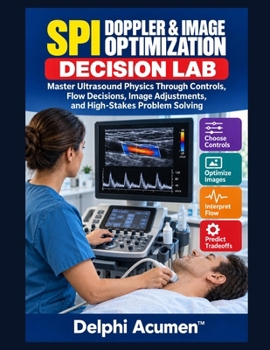
SPI Doppler & Image Optimization Decision Lab: Master Ultrasound Physics Through Controls, Flow Decisions, Image Adjustments, and High-Stakes Problem

The waveform wraps, the image loses detail, and two controls seem equally plausible. Before choosing an adjustment, you need to identify the physical cause and anticipate what else will change. SPI Doppler & Image Optimization Decision Lab brings that console-level reasoning into structured preparation for the Sonography Principles and Instrumentation examination.
Begin with the observed problem and follow the relationship behind it. The book's Decision Lab sequence asks you to observe the image, waveform, or condition; identify the governing physics; choose the direct control or principle; and predict the intended effect and its tradeoff. Explain what a setting changes and what it leaves unchanged.
Connect the physics to the controlThe opening chapters build a foundation in acoustic relationships and instrumentation. Work through frequency, wavelength, attenuation, pulse timing, beam characteristics, transducer behavior, and resolution before connecting them to practical settings. Tables, diagrams, formulas, and decision sheets organize changes in depth, focus, frequency, and acquisition timing.
Image optimization begins with naming the defect precisely. Distinguish brightness, penetration, contrast, spatial detail, and temporal performance before choosing a control. The teaching distinguishes gain and time gain compensation from output power, links focal choices to beam width, and examines the consequences of depth, sector width, line density, persistence, and other adjustments.
Doppler questions ask you to separate geometry, sampling, filtering, and display. Explore angle, pulse repetition frequency, scale, wall filter, sample gate, gain, baseline, and color priority through cause-and-effect decisions. The material compares pulsed-wave and continuous-wave Doppler, examines aliasing and spectral broadening, and connects flow information with hemodynamic relationships.
Test the choice before reading the explanationFive 100-question practice tests provide a staged route through the material. Move from physics recognition and control identification to optimization sequence, applied sonographic cases, artifacts and competing adjustments, and integrated problem solving. Complete each test before opening its answer key to separate independent retrieval from guided review.
Teaching rationales turn each reviewed answer into a physical explanation. They identify the principle, apply it to the stated conditions, examine competing choices, and highlight the boundary or tradeoff that separates them. Mastery dashboards organize weak areas; targeted retakes revisit the skill through a different application.
Return to the console with a more organized reviewSafety and quality assurance remain part of the decision. The book includes acoustic output considerations, prudent exposure principles, transducer integrity, phantom-based checks, and quality-assurance reasoning. The final-day command center gathers formulas, artifacts, control interactions, comparisons, and decision maps for focused consolidation.
This independent resource is written for sonography students and professionals preparing for SPI. Connect the visible problem with its mechanism, explain the control choice, and anticipate the consequence. It is not affiliated with the examination sponsor, does not reproduce live examination questions, and does not guarantee a result. The study task remains concrete: observe, identify, decide, and predict.
Customer Reviews
ThriftBooks ® and the ThriftBooks ® logo are registered trademarks of Thrift Books Global, LLC
